
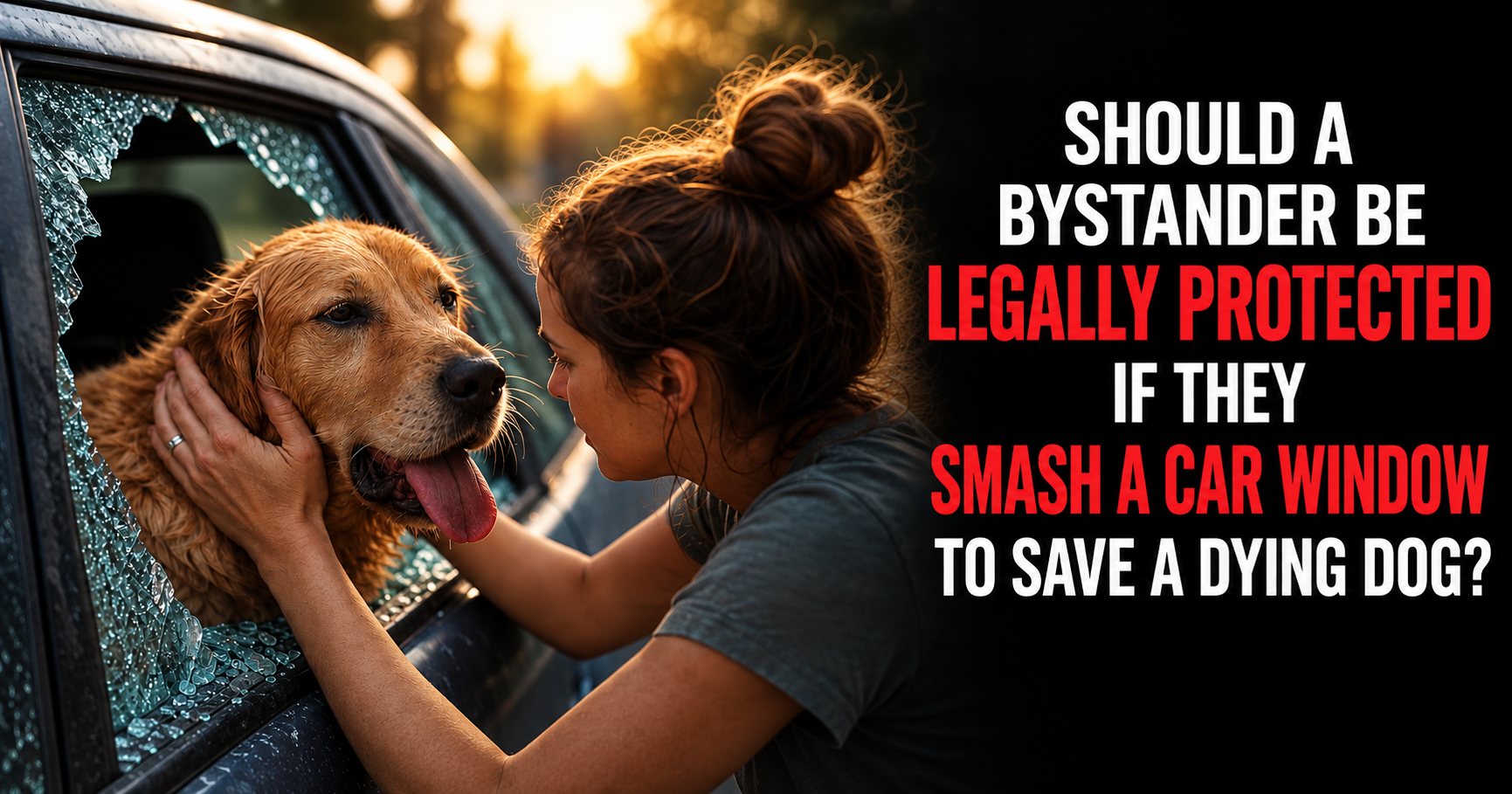
You see the dog before you see the owner.
It is alone inside a parked car on a hot afternoon. The windows are closed. Its mouth is open, its breathing looks heavy, and nobody nearby seems to know who owns the vehicle.
You pull the door handle.
Locked.
Now imagine standing there with something heavy enough to break the glass.
Would you do it?
For many animal lovers, the moral answer feels immediate. But the legal answer is much more complicated.
A parked car can become dangerous frighteningly fast
Leaving a dog inside a hot vehicle isn’t comparable to leaving it outside in the same temperature.
According to the American Veterinary Medical Association, the temperature inside a vehicle can rise by about 19°F in just 10 minutes and approximately 29°F within 20 minutes.
That means an apparently ordinary trip into a store can become dangerous far faster than many people realize.
Cracking the windows is not a reliable solution to the underlying danger. Dogs are also vulnerable to heat because their primary cooling mechanisms differ from ours.
For the person standing outside the vehicle, however, another problem begins immediately.
You may believe the dog needs help.
But are you legally allowed to break someone else’s window?
The answer depends on where you are
In the United States, there is no single nationwide rule giving every bystander an unconditional right to smash a vehicle window whenever an animal appears to be in danger.
State laws vary considerably.
As of 2026, the Animal Legal & Historical Center at Michigan State University College of Law reports that 32 states and the District of Columbia have laws concerning companion animals left unattended in parked vehicles under dangerous conditions.
But those laws do not all work the same way.
Some states authorize police officers, firefighters, animal control officers or other designated responders to enter a vehicle.
Others have what are commonly described as Good Samaritan rescue provisions, which can protect ordinary citizens from certain civil liability when they forcibly enter a vehicle to rescue an animal in imminent danger.
And some states do not provide comparable protection to an ordinary bystander.
That difference matters enormously.
Even a Good Samaritan law may come with conditions
Seeing a dog in distress does not necessarily mean you can immediately pick up a rock and smash the nearest window.
Where civilian rescue protections exist, they can require specific steps before immunity applies.
Depending on the state, those requirements may include determining that the vehicle is actually locked, making a reasonable attempt to locate the owner, contacting 911 or law enforcement before entering, having a reasonable belief that the animal faces imminent danger, using no more force than necessary, and remaining with the animal until authorities arrive.
For example, summaries of state statutes maintained by the Animal Legal & Historical Center show that requirements and the people authorized to perform a rescue differ significantly from one jurisdiction to another.
Failing to follow the applicable procedure could affect whether legal protection applies.
So there is an important distinction:
Believing you are doing the right thing and being legally protected for doing it are not always the same thing.
What should you do if you find a dog trapped in a hot car?
First, assess the situation quickly.
Look for obvious signs of distress and see whether the owner can be located immediately. Note the vehicle’s location, description and license plate.
Contact local law enforcement, emergency services or animal control as appropriate and explain that an animal appears to be trapped in dangerous conditions.
If the situation appears immediately life-threatening, tell the dispatcher exactly what you are seeing and follow emergency instructions.
Before forcibly entering the vehicle yourself, however, you need to understand that the law governing civilian rescue depends on your jurisdiction.
Do not assume that something you saw someone legally do in California, Florida or another state is automatically legal where you live.
Why isn’t there one simple rule?
The issue involves two legitimate legal concerns that can collide in a matter of minutes.
One is protecting an animal from serious injury or death.
The other involves entering and damaging someone else’s property.
Good Samaritan laws attempt to address that conflict by defining circumstances in which a person acting reasonably to prevent imminent harm receives legal protection.
But states have drawn those boundaries differently.
Some give ordinary citizens a carefully defined path to intervene. Others reserve forcible entry primarily for law enforcement or other authorized responders.
That is why knowing your local law before an emergency happens can be surprisingly important.
Imagine being the person standing beside that window
Forget the statutes for a moment.
There is a frightened dog on the other side of the glass.
It cannot open the door.
It cannot call the police.
It cannot explain that it is overheating.
It is completely dependent on the decisions human beings make around it.
Now the legal question becomes deeply human:
Should someone who reasonably believes an animal is facing imminent death be protected when they cause limited property damage to save that life?
Some states have answered that question by extending conditional immunity to rescuers. Others have taken a narrower approach.
But regardless of where the law draws the line, one fact remains painfully simple.
A hot vehicle can become dangerous much faster than many people expect.
And the easiest rescue is the one that never has to happen.
If conditions could become dangerous, leave your dog safely at home rather than alone inside a parked vehicle.
Because no shopping trip, quick errand or few minutes of convenience is worth gambling with an animal’s life.
And no stranger in a parking lot should have to decide between watching a dog suffer and wondering whether saving it will put them on the wrong side of the law.
Leave a Reply