

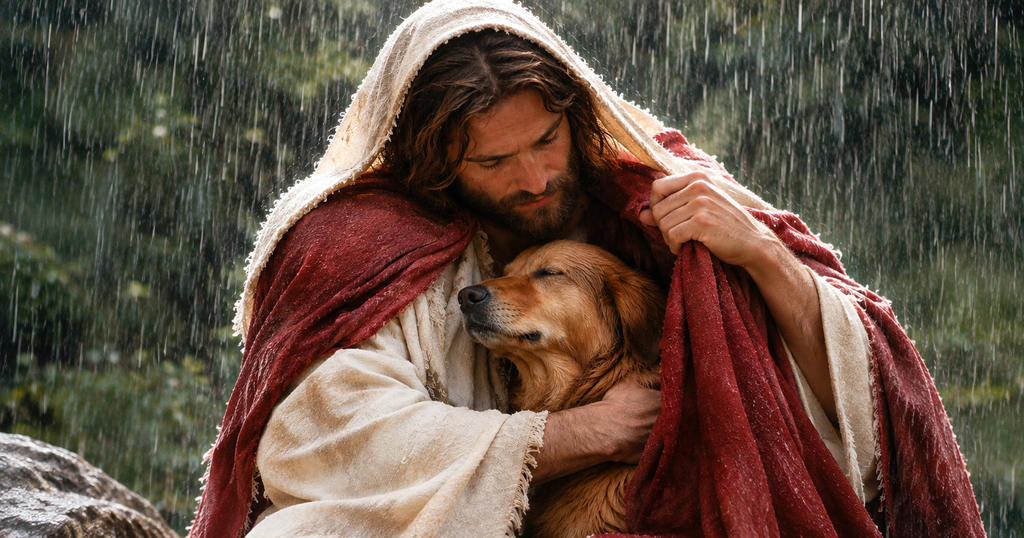
The rain was falling hard. The wind was cold, and the world seemed to have forgotten a small, helpless dog searching for somewhere safe to rest.
Then, in this imagined moment, someone stopped.
It was Jesus.
Instead of walking past, He knelt beside the trembling animal, opened His cloak, and gently pulled the dog into His arms. The rain continued to fall, but beneath that simple shelter, the little creature was no longer alone.
There were no crowds watching. No applause. No grand miracle for the world to witness.
Just a moment of kindness between a gentle Savior and a vulnerable animal.
This touching image of Jesus sheltering a dog from the rain carries a message that goes far beyond the picture: love is not measured by how important someone appears, but by how willingly we care for those who need us.
When the World Walks Past, Love Stops
Imagine being that little dog.
Cold, exhausted, and frightened, with nowhere to go. Every passing footstep brings a moment of hope, followed by disappointment as another person continues walking.
Perhaps someone notices but decides there is nothing they can do.
Perhaps others are simply too busy.
Then someone finally stops.
The most powerful part of this image is not the storm or even the red cloak shielding the animal. It is the simple decision to care.
Jesus is portrayed holding the dog close, protecting it from the rain without expecting anything in return.
That is what compassion looks like.
In the Bible, Jesus repeatedly demonstrated concern for those who were overlooked, rejected, or suffering.
He welcomed children, showed kindness to people society had pushed aside, and taught His followers to love others with sincerity.
The image of Him protecting a helpless animal is an artistic reflection of that same spirit of mercy.
It invites us to ask a deeply personal question:
When we encounter someone who is suffering, do we keep walking, or do we stop?
God’s Love Is Bigger Than We Often Imagine
People sometimes forget that the natural world also has a place in the biblical story of creation.
Animals are not merely decorations in our lives. They are living creatures capable of experiencing fear, comfort, trust, and affection.
The Bible repeatedly acknowledges God’s care for the world He created.
In Matthew 10:29, Jesus speaks about sparrows and reminds His listeners that even these small birds are not forgotten by the Father.
The message is especially comforting because sparrows were considered creatures of little monetary value.
Yet they still mattered.
Psalm 145:9 also describes God’s compassion as extending over all His works.
These passages do not tell the specific story shown in the image. Instead, they provide a biblical foundation for reflecting on God’s concern for creation.
The dog resting beneath Jesus’ cloak becomes a symbol of something beautiful.
Even the smallest life deserves tenderness.
Even a creature that cannot speak deserves protection.
And even when the world seems indifferent, kindness can transform fear into peace.
Perhaps that is why this image feels so emotional.
The dog does not understand theology or religious teachings. It does not know how to pray or express gratitude in words.
It simply recognizes safety.
And sometimes, feeling safe in someone’s arms is enough.
The Storm May Continue, But Love Can Become a Shelter
Look closely at the scene.
The rain has not stopped.
The clouds have not disappeared.
The world around Jesus and the dog is still wet and cold.
Yet something important has changed.
The dog is no longer facing the storm alone.
This detail carries a meaningful lesson about faith.
Many people turn to God hoping that every difficulty will immediately disappear. They pray for relief from illness, loneliness, grief, uncertainty, and fear.
But life does not always change as quickly as we wish.
Sometimes the storm continues.
The Christian message of comfort is not that believers will never experience suffering. It is that hardship does not have to mean abandonment.
In this image, the cloak represents protection, while the embrace represents the comfort of being cared for.
The dog still hears the rain.
It still feels the cold air beyond the shelter.
But it can finally rest.
For anyone going through a difficult season, that picture may offer a quiet reminder:
Peace does not always begin when the storm ends. Sometimes it begins when we realize we are not alone.
What a Small Dog Can Teach Us About Compassion
There is another important lesson hidden in this simple scene.
The dog has nothing valuable to offer in return.
It cannot repay the kindness with money, recognition, or a promise of future assistance.
It can only receive the warmth being offered.
And that is precisely what makes the act of compassion meaningful.
Genuine kindness is not a transaction.
It is a decision to recognize suffering and respond with care.
Jesus taught His followers to love beyond convenience and personal benefit.
The parable of the Good Samaritan, found in Luke 10:25–37, illustrates how compassion requires action rather than good intentions alone.
The Samaritan did not merely feel sorry for the injured traveler. He stopped and helped.
The same principle can guide how we treat vulnerable animals.
A hungry stray dog may need food.
An abandoned animal may need a safe home.
A frightened pet may need patience rather than punishment.
And sometimes, an animal caught in terrible weather simply needs someone willing to offer shelter.
Small acts of kindness may seem insignificant to the person performing them.
But to the creature receiving them, those actions can mean everything.
Be Someone’s Shelter Today
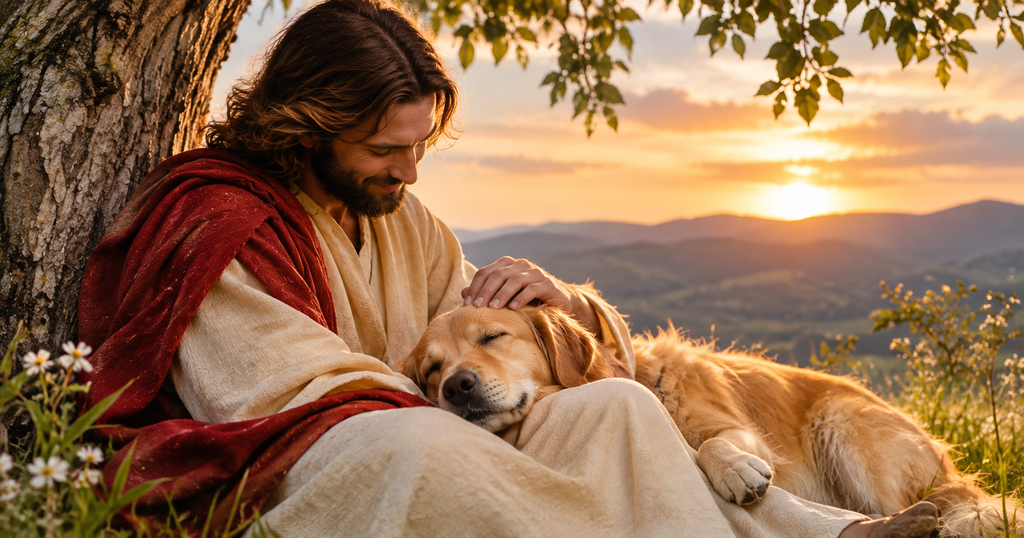
Perhaps the most moving part of this image is how ordinary the act of kindness really is.
There is no extraordinary display of power.
Only a cloak, an embrace, and a willingness to protect a vulnerable life.
It reminds us that compassion does not always require wealth, influence, or remarkable abilities.
Sometimes it requires only attention.
We can notice the elderly neighbor who feels forgotten.
We can comfort a friend who is struggling silently.
We can offer food and water to an animal in need.
We can choose patience when frustration would be easier.
And we can remember that every act of kindness contributes to a world that desperately needs more tenderness.
The image of Jesus sheltering a dog from the rain invites us to practice the mercy we admire.
Not only in our prayers.
Not only in our words.
But in the way we treat living beings who depend on our compassion.
Final Thoughts: Love Is the Greatest Shelter
One day, the rain in this imagined scene will stop.
The clouds will part, the ground will dry, and the little dog will be able to walk into the sunlight again.
But the most beautiful part of the story is not the sunshine waiting beyond the storm.
It is the kindness that appeared while the rain was still falling.
That is the message this image leaves behind.
We may not be able to stop every storm in another creature’s life.
We may not have the power to solve every problem or remove every sorrow.
But we can offer warmth.
We can offer protection.
We can choose compassion.
And sometimes, that simple act of love is enough to remind a frightened heart that it has not been forgotten.
May we all learn to become a shelter for someone who needs one, whether they walk on two legs or four.
Leave a Reply