
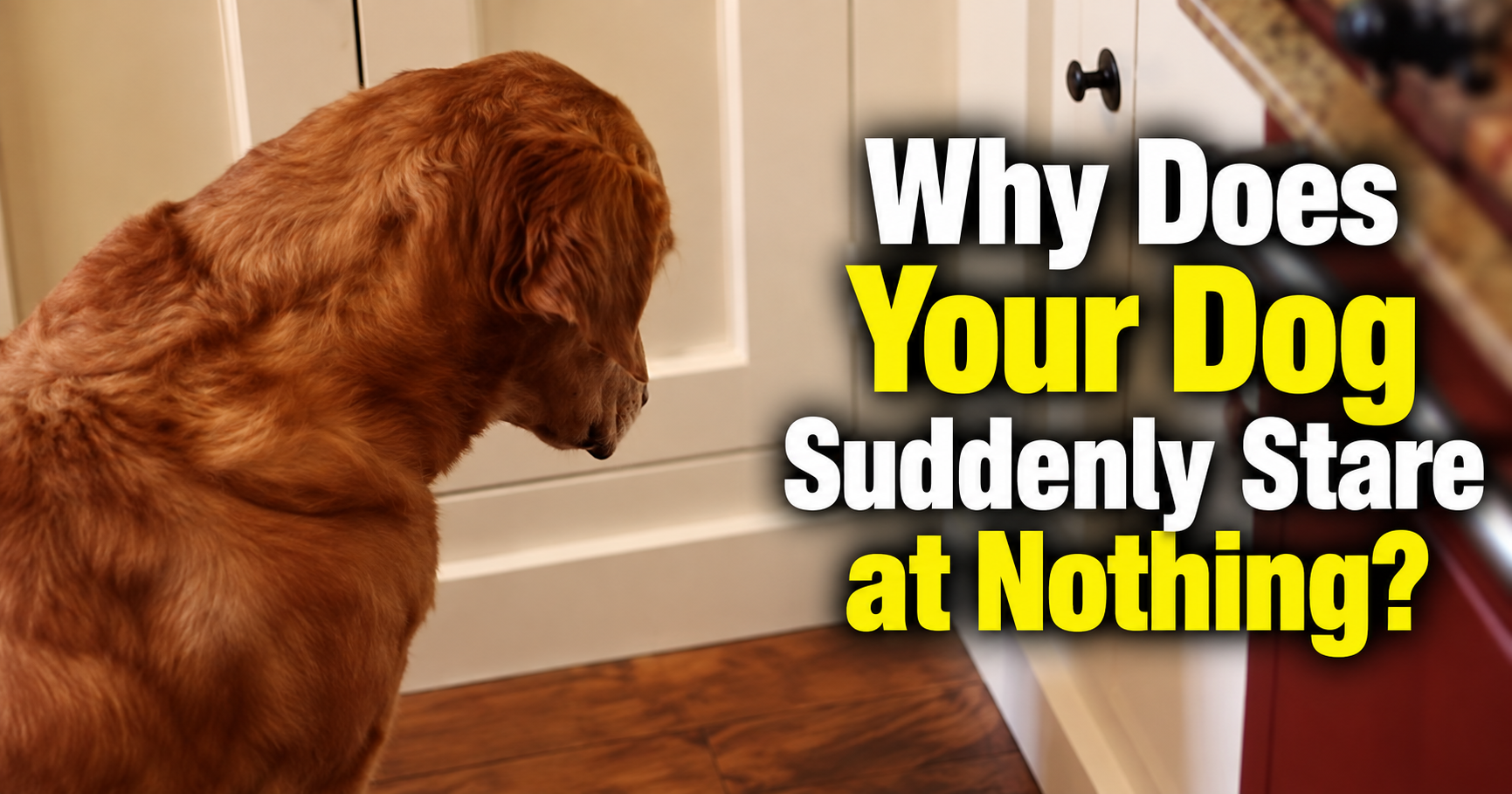
A dog staring at nothing can be one of the strangest things to watch.
One moment, your dog is lying peacefully beside you. Then its head suddenly rises. Its ears move forward. Its eyes lock onto an empty corner of the room.
You look in the same direction.
Nothing is there.
But your dog keeps staring.
Maybe it gets up and walks toward the wall. Maybe it tilts its head as though it can hear something. Some dogs even begin sniffing the air or remain completely still for several seconds.
It can make you wonder: What does my dog see that I can’t?
Before assuming anything mysterious is happening, there is something important to remember. Dogs experience the same house we do, but they don’t experience it in exactly the same way.
Your dog may hear sounds you miss, detect scents you cannot smell, or notice tiny movements that never attract your attention.
So when your dog appears to stare at nothing, there may actually be something there. You just can’t detect it.
Why is my dog staring at nothing?
There isn’t one explanation for every dog staring at nothing.
Sometimes the cause may be as simple as a faint sound behind the wall. Other times, your dog may have detected an interesting scent or noticed a tiny movement.
Dogs also learn routines and associations. A seemingly empty doorway, hallway or corner may have meaning because something interesting regularly happens there.
The key is to pay attention to what your dog does while staring.
Are its ears moving?
Is its nose working?
Does it tilt its head?
Does it suddenly walk toward the wall?
Does it respond normally when you call its name?
Those small details can help explain what has captured its attention.
Your dog may hear something you can’t
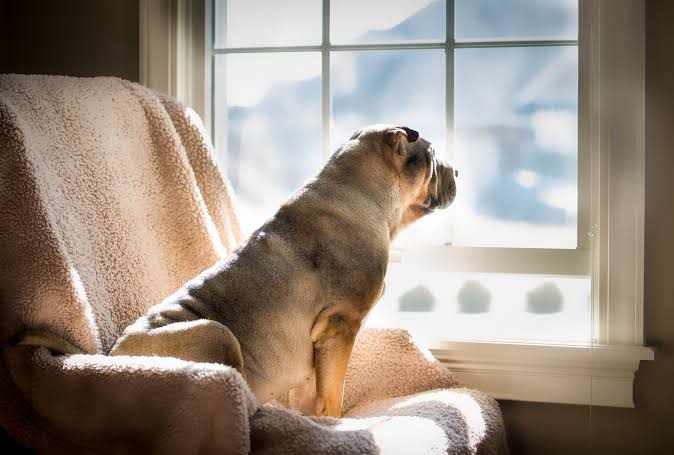
One of the most likely explanations is hearing.
Dogs can detect higher-frequency sounds than humans can. They may also notice quiet noises that simply disappear into the background for us.
Imagine your dog suddenly staring at a wall.
To you, the room seems completely silent.
But your dog might be listening to a mouse moving behind the drywall, an insect, water traveling through a pipe, a heating system switching on, footsteps elsewhere in the building, or activity outside.
Even an ordinary household can contain an enormous number of subtle sounds.
Your dog doesn’t need to understand what produced the sound. It only needs to notice that something unusual is happening in a particular direction.
This may explain why a dog sometimes stares at a wall while moving its ears or tilting its head.
It may not be looking at the wall at all.
It may be listening through it.
A dog’s sense of smell can reveal an invisible world
Hearing is only part of the explanation.
Dogs rely heavily on smell to understand their environment.
Humans tend to walk into a room and immediately notice what we can see. We see furniture, windows, people and objects.
A dog’s experience is far more scent-oriented.
Someone may have walked through the room earlier.
Another animal could have passed outside.
A small creature may be hiding nearby.
Air moving through a vent or open window can carry odors from somewhere else.
To you, there is simply an empty corner.
To your dog, that same corner may contain information.
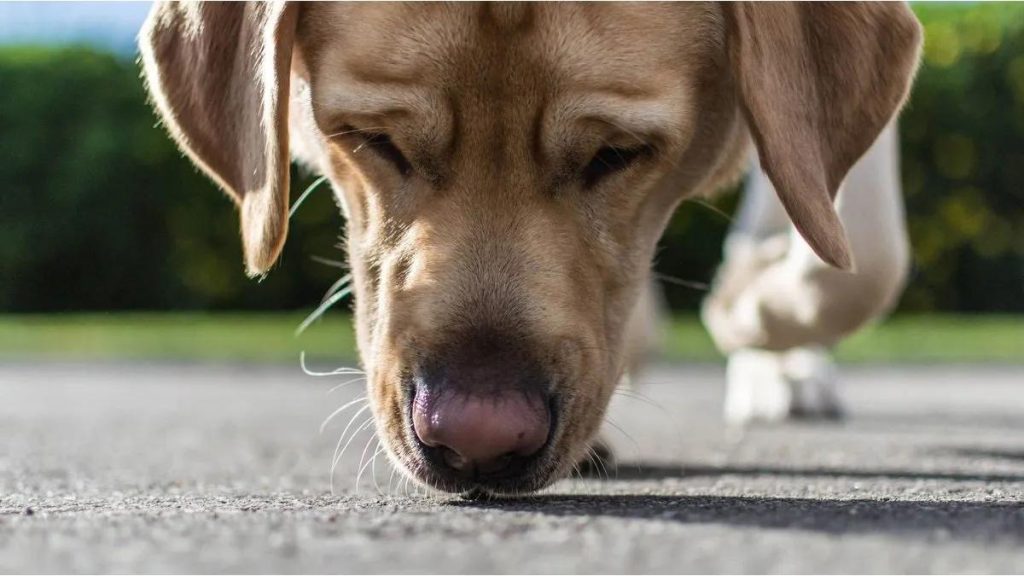
This is particularly interesting when a dog begins staring and then starts sniffing.
The staring may be the behavior you notice first, but smell could be an important part of whatever caught the dog’s attention.
A dog staring at nothing may be watching tiny movements
Sometimes the mysterious object is actually visible.
You simply haven’t noticed it.
A tiny insect moves across the wall.
A curtain shifts slightly.
Dust passes through sunlight.
A reflection from a phone, television, mirror or passing vehicle moves across the ceiling.
A shadow changes.
Your dog notices.
You don’t.
Dogs don’t see the world exactly as humans do, and movement can be particularly important in attracting their attention.
This can create a surprisingly eerie moment.
Your dog suddenly freezes.
It looks intensely at a blank wall.
You follow its gaze and see absolutely nothing.
Thirty seconds later, your dog walks away as though nothing happened.
Whatever captured its attention may have disappeared before you ever found it.
Your dog may be waiting for someone
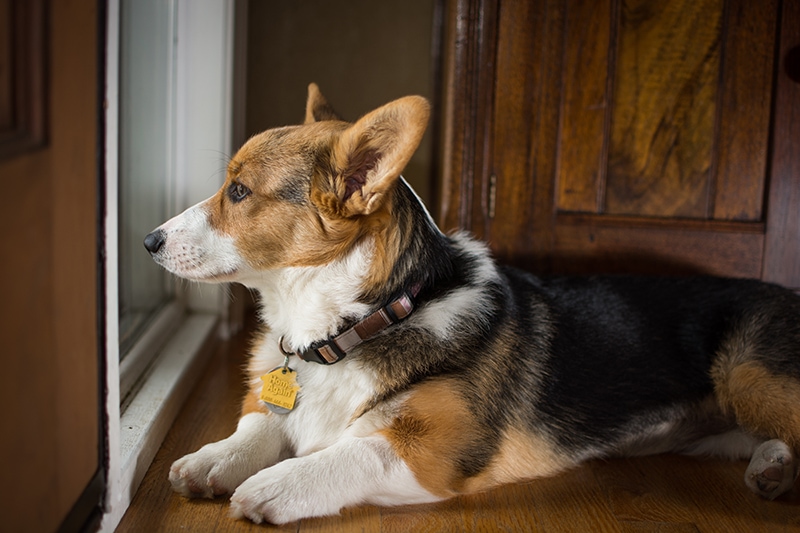
Not every stare is caused by something currently happening.
Dogs are excellent at learning patterns.
Suppose someone in your family usually comes through the same doorway every evening.
Your dog learns that routine.
Or perhaps another pet frequently appears from a particular room.
Maybe the sound of a neighbor’s car normally happens shortly before your partner comes home.
Eventually, the location itself can become meaningful.
Your dog may stare toward the door before anyone appears.
Then someone walks through it.
From your perspective, the timing seems extraordinary.
But your dog may simply have recognized a familiar sequence before you did.
This is similar to why some dogs appear to know when their owners are late coming home. They cannot read a clock, but they can learn routines and environmental cues.
You can read more about that behavior here:
https://petespetsupply.net/can-dogs-tell-when-you-are-late/
Suggested anchor text: how dogs seem to know when you’re late
Why does my dog stare at nothing at night?
A dog staring at nothing can feel particularly strange at night.
Imagine lying in bed when your dog suddenly raises its head.
It looks past you.
Its ears become alert.
Then it stares into a dark hallway.
You hear nothing.
Moments like this have helped create the popular idea that dogs can sense ghosts or supernatural presences.
There is no established scientific evidence showing that dogs can see ghosts.
There are, however, plenty of ordinary things dogs can detect more effectively than humans.
At night, the house becomes quieter.
Background noises decrease.
That may make distant or subtle sounds easier to detect.
Your dog could hear an animal outside, a pipe changing temperature, a car door closing in the distance or movement elsewhere in the building.
A smell could also drift through an open window or ventilation system.
Your dog reacts.
You detect nothing.
That doesn’t mean the dog is responding to something supernatural.
It may simply mean your dog’s senses picked up information yours didn’t.
Can dogs see things humans can’t?
In one sense, yes, but not in the supernatural way the question is usually asked.
Dogs and humans have different sensory abilities.
Dogs can hear frequencies beyond the upper range of normal human hearing. Their sense of smell is also vastly more important and sensitive than ours.
Their visual system differs from ours as well.
This means your dog can sometimes react to environmental information that you cannot easily perceive.
So when your dog suddenly looks toward an apparently empty space, the safest explanation isn’t that it sees a ghost.
It is that your dog may be detecting the ordinary world differently from you.
For more about the surprising abilities dogs possess, see:
https://petespetsupply.net/7-interesting-facts-about-dogs-that-may-change-the-way-you-see-your-best-friend/
Suggested anchor text: surprising facts about how dogs experience the world
Could your dog be remembering something?
There is another possibility.
Dogs can form associations between places and experiences.
Suppose your dog’s favorite person normally enters through one doorway.
Even when that person isn’t there, the doorway may still attract attention.
A particular corner may be associated with another pet.
A window may be associated with squirrels appearing outside.
A kitchen doorway may predict food.
Your dog does not necessarily need to detect something new.
It may simply be expecting something familiar.
Humans do this too.
If you’re waiting for someone to arrive, you may repeatedly look toward the door even though nobody is standing there.
The difference is that you can explain why you’re looking.
Your dog can’t.
Why does my dog stare at the wall?
A dog staring at a wall can have many of the same explanations.
There may be noises inside or behind the wall. Pipes, insects, rodents, ventilation systems and activity in neighboring rooms can all create sounds.
However, repeated wall staring deserves more attention if it is accompanied by other behavioral changes.
An occasional glance at the wall followed by normal behavior is very different from a dog repeatedly standing in front of walls and appearing confused.
That distinction becomes particularly important with senior dogs.
When a dog staring at nothing may be a health concern
Most occasional staring isn’t necessarily a reason for alarm.
But behavior should always be considered in context.
If staring suddenly becomes frequent, lasts for unusually long periods, or occurs alongside other changes, it is worth discussing with your veterinarian.
Pay particular attention if your dog also:
- seems confused in familiar surroundings
- becomes stuck in corners
- paces repeatedly
- has major changes in sleeping patterns
- stops responding normally to familiar sounds or commands
- shows repetitive or unusual movements
- appears difficult to interrupt during staring episodes
- develops tremors, weakness or collapse
- suddenly behaves very differently from normal
These signs do not automatically mean your dog has a particular medical condition.
There are many possible explanations.
But significant changes in behavior deserve professional evaluation.
For general guidance about changes in your dog’s behavior and health, the American Veterinary Medical Association (AVMA) provides reliable pet-health information for owners.
Suggested anchor text: pet health guidance from the American Veterinary Medical Association
Pay extra attention to senior dogs
Age matters.
An older dog occasionally turning toward a sound is not necessarily unusual.
But repeated staring combined with confusion, wandering, sleep changes, house-soiling, altered interactions or getting stuck in familiar places can be more significant.
Senior dogs can experience changes in hearing and vision, and some also develop age-related cognitive changes.
If you notice a new pattern, don’t simply assume your dog is “getting old.”
Watch the behavior carefully and discuss meaningful changes with your veterinarian.
If possible, record a video.
A video can be particularly useful because unusual staring may not happen while your dog is actually at the veterinary clinic.
What should you do when your dog stares at nothing?
First, don’t panic.
Observe.
Look in the direction your dog is watching.
Listen carefully.
Check for reflections or insects.
Notice whether your dog’s ears are moving.
Watch whether it begins sniffing.
Then gently call your dog’s name.
If it immediately turns toward you, behaves normally and soon returns to whatever it was doing, there may be little reason for concern.
You might never discover what captured its attention.
That’s okay.
Dogs don’t experience their surroundings only through the things humans can see and hear.
Your dog lives in a different version of your home
Perhaps this is the most fascinating explanation for a dog staring at nothing.
You and your dog can occupy exactly the same room while experiencing two very different versions of it.
You notice the television.
Your dog notices something moving outside.
You see a wall.
Your dog hears something behind it.
You see an empty hallway.
Your dog detects a familiar scent.
You see an empty corner.
Your dog suddenly raises its head and stares.
Maybe it heard a mouse.
Maybe it saw a tiny reflection.
Maybe someone walked outside.
Maybe a familiar scent moved through the room.
Or perhaps your dog simply expected something to happen there.
You may never know exactly what caught its attention.
But next time your dog suddenly freezes and looks intensely at an apparently empty space, remember this:
“Nothing” to you may not be nothing to your dog.
Leave a Reply