

You cover your face with your hands.
Your voice changes. You pretend to cry.
Within seconds, your dog stops what it’s doing and walks toward you. Maybe it puts its head on your lap. Maybe it nudges your hand, licks your face, or simply sits quietly beside you.
It certainly looks like your dog knows you’re sad.
But there’s a fascinating question hidden inside that moment:
Can dogs tell when you’re pretending to be sad?
Dogs cannot ask us whether our tears are real. Yet research suggests they are remarkably sensitive to human emotional signals. They can respond to facial expressions, voices, body language, odors and learned patterns.
So pretending to cry may be more complicated than you think.
Dogs pay much more attention to you than you realize
Dogs have spent thousands of years living alongside humans.
During an ordinary day, your dog is constantly exposed to your movements, routines and reactions.
It learns what happens when you pick up your keys.
It recognizes the sounds associated with food.
It may notice the difference between the clothes you wear around the house and the ones you put on before leaving.
And it pays attention to your emotional behavior too.
Research has shown that dogs can distinguish between different emotional information presented through human faces and voices. Studies have also found evidence that dogs can integrate emotional cues rather than responding to only one signal in isolation.
That matters when you’re pretending to be sad.
You might be able to fake a crying sound.
But your voice is only one part of what your dog is experiencing.
Can dogs recognize sadness in humans?

Evidence suggests dogs can discriminate between some human emotional expressions.
In one study published in Current Biology, researchers found evidence that dogs could distinguish emotional expressions in human faces.
Other research has explored how dogs process emotional information contained in voices and how they respond to emotional interactions between people.
That doesn’t mean a dog understands sadness exactly as a human does.
Your dog probably isn’t thinking:
“My owner is experiencing the psychological state humans call sadness.”
Instead, it may recognize a combination of signals associated with something unusual or emotionally important.
Your face changes.
Your posture changes.
Your voice sounds different.
Your behavior becomes unfamiliar.
And your dog notices.
But what happens when the sadness is fake?
This is where things become particularly interesting.
Suppose you pretend to cry.
You make convincing sounds. You cover your face. Maybe you lower your head.
Those cues may resemble genuine distress.
Your dog might therefore approach you, touch you, lick you or remain nearby.
But real sadness can involve signals that are much harder to deliberately reproduce.
Your breathing may change.
Your movements may become different.
Your facial muscles behave naturally rather than theatrically.
Your voice changes in subtle ways.
And even your body odor may change with emotional states.
So while you may fool your dog’s ears, other information may not match.
Scientists cannot simply ask a dog whether it knows someone is “pretending.” That means we should be careful about claiming dogs understand deception in the same abstract way humans do.
A more accurate explanation is fascinating enough:
Your dog may be comparing several signals at once, and sometimes those signals don’t tell the same story.
Your scent may reveal more than your face

Humans naturally focus on faces.
Dogs live much more through their noses.
That creates an intriguing possibility.
Research has found that dogs can respond differently to human body odors collected during different emotional states. Studies involving odors associated with fear or happiness have suggested that human emotional chemosignals can influence canine behavior.
This doesn’t mean dogs can literally “smell sadness” with perfect accuracy.
But it does suggest that emotional changes can produce chemical information dogs may detect.
Now imagine pretending to cry while you’re actually feeling perfectly relaxed.
Your face says one thing.
Your voice says another.
But your body’s chemical signals may not match the performance.
Whether an individual dog interprets that mismatch as “my human is pretending” is unknown.
Still, it demonstrates why fooling a dog’s senses may be more complicated than simply making a sad face.
Dogs can also read your voice
Your dog’s ears matter too.
Dogs don’t need to understand every word you say to notice changes in how you say them.
Pitch, rhythm, intensity and tone can all provide information.
Think about how differently you say:
“Do you want a treat?”
compared with:
“What did you do?”
Even without understanding the complete sentence, many dogs respond very differently.
The same principle can apply to emotional vocalizations.
A genuine cry and an exaggerated pretend cry may sound similar to us, but subtle differences could matter to a dog.
Of course, dogs vary enormously.
One dog may immediately approach.
Another may stare at you.
Another might bring a toy.
And another may simply continue sleeping.
None of these responses alone proves exactly what the dog believes.
Why does your dog comfort you when you cry?
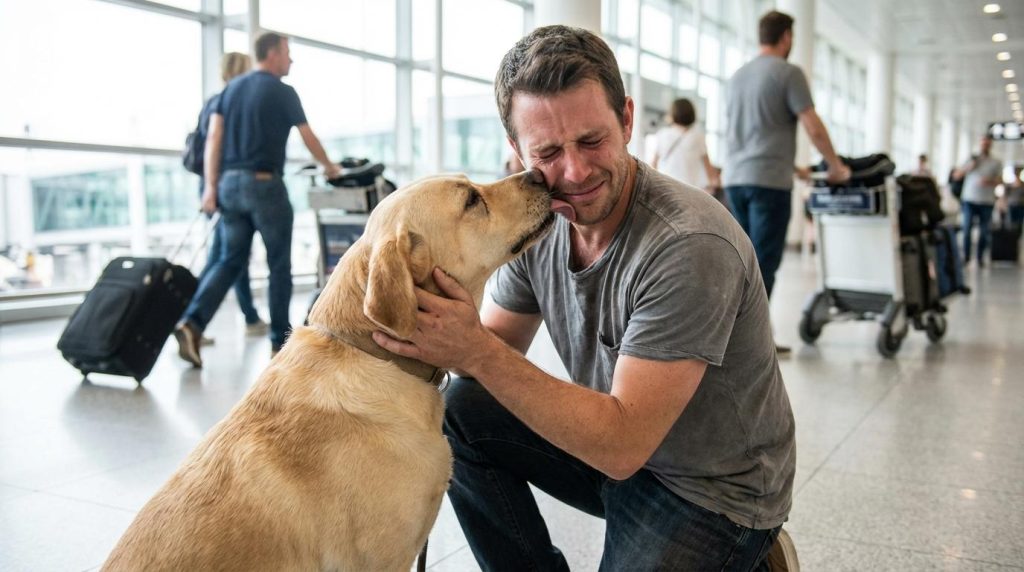
This behavior has fascinated researchers for years.
Experiments have found that dogs may approach people who appear to be crying or distressed, including under certain controlled conditions.
One frequently discussed study found that dogs were more likely to approach a person who was crying than when the person was humming or talking.
Interestingly, their response wasn’t limited only to their owners.
That suggests crying itself may function as an emotionally meaningful cue for some dogs.
But there is an important distinction.
Responding to distress isn’t necessarily the same as understanding distress exactly as humans do.
A dog approaching someone who cries could involve emotional contagion, learned behavior, curiosity, attachment, previous reinforcement or some combination of these mechanisms.
The affectionate behavior is real.
The precise mental experience behind it is much harder to prove.
Your dog has been studying your personal patterns
Scientific experiments tell us about dogs generally.
But your own dog has something researchers in a laboratory don’t have:
years of experience with you.
Your dog may know your routines extraordinarily well.
It knows how you normally walk through the house.
It knows what happens before bedtime.
It recognizes the sounds you make when you’re excited.
It may know that grabbing a particular bag means you’re leaving.
Over time, your dog may also learn patterns associated with your emotional states.
Perhaps you become quieter when you’re genuinely upset.
Maybe you sit in a particular place.
Your movements slow down.
Your voice becomes softer.
You interact less.
A fake crying performance may reproduce one or two of these signals but not the entire pattern.
Your dog may therefore react differently without necessarily understanding the concept of acting.
Dogs are creatures of habit, and they often become familiar with their owners’ daily routines. They may notice when someone arrives home later than usual, even without understanding time the way humans do. Learn more about how dogs know when you’re late and the subtle cues they use to anticipate your return.
Why might your dog bring you a toy when you’re sad?
Not every dog responds to apparent sadness by cuddling.
Some bring toys.
Some paw at their owners.
Others lick them repeatedly.
A dog may even become playful.
At first, this can look like the dog doesn’t understand what’s happening.
But there may be another explanation.
Your dog has learned certain behaviors that create interaction.
Bringing a toy makes you respond.
Licking gets your attention.
Climbing onto your lap creates physical contact.
From the dog’s perspective, these may be effective responses when your normal behavior suddenly changes.
Whether we call that comforting depends partly on how we define the word.
But the interaction itself can still be meaningful.
Can your dog tell you’re acting?
We don’t currently have evidence showing that dogs reliably understand human acting or deception in the sophisticated way people do.
That’s an important distinction.
A dog reacting differently to genuine and simulated emotions would not automatically prove that it understands:
“My owner is pretending.”
It could simply be responding to differences in voice, movement, scent or context.
Dogs don’t need to understand acting to notice that something doesn’t add up.
Imagine hearing someone laugh while their facial expression remains completely serious.
You immediately notice a mismatch.
A dog may similarly receive conflicting information from multiple senses.
Scientists are still investigating how dogs combine those signals.
Your dog may notice when something about you changes

This ability becomes even more interesting when considered alongside other dog behaviors.
Your dog may seem to know when you’re leaving before you touch the door.
It may wait for you around the time you normally return.
It may suddenly stare toward an apparently empty corner because it detected a sound or scent you missed.
These behaviors can seem mysterious because humans naturally judge the environment through human senses.
Dogs don’t.
They inhabit a world dominated far more heavily by scent and filled with sounds we may never consciously notice.
You can explore another example here:
https://petespetsupply.net/dog-staring-at-nothing/
Suggested anchor: why dogs sometimes stare at apparently empty spaces
Should you pretend to cry to test your dog?
Doing it once out of curiosity is unlikely to tell you very much scientifically.
Your dog’s reaction could depend on personality, previous experiences, your performance, the environment and even what it was doing immediately beforehand.
Repeatedly creating distress signals simply to provoke a reaction also isn’t necessary.
A much better experiment is observation.
Notice what your dog naturally does when you’re genuinely upset.
Does it approach?
Stay nearby?
Become quieter?
Bring something?
Watch you from across the room?
Or behave exactly as usual?
There isn’t one response that proves your dog loves you more than another.
Individual dogs communicate differently.
So, does your dog know you’re pretending?
The most scientifically responsible answer is:
Maybe it notices something is different, but we cannot say that it understands you’re “pretending” in the human sense.
What makes the question fascinating is how many clues your dog may have available.
Your face.
Your voice.
Your posture.
Your movements.
Your breathing.
Your routine.
Possibly even changes in your scent.
You might think you’re giving your dog one piece of information.
In reality, your dog may be receiving many.
And some of them are extremely difficult to fake.
So the next time you cover your face, make a crying sound and watch your dog immediately look up, remember:
Your dog may not understand the performance. But it may know you well enough to notice when something doesn’t quite match.
Leave a Reply