
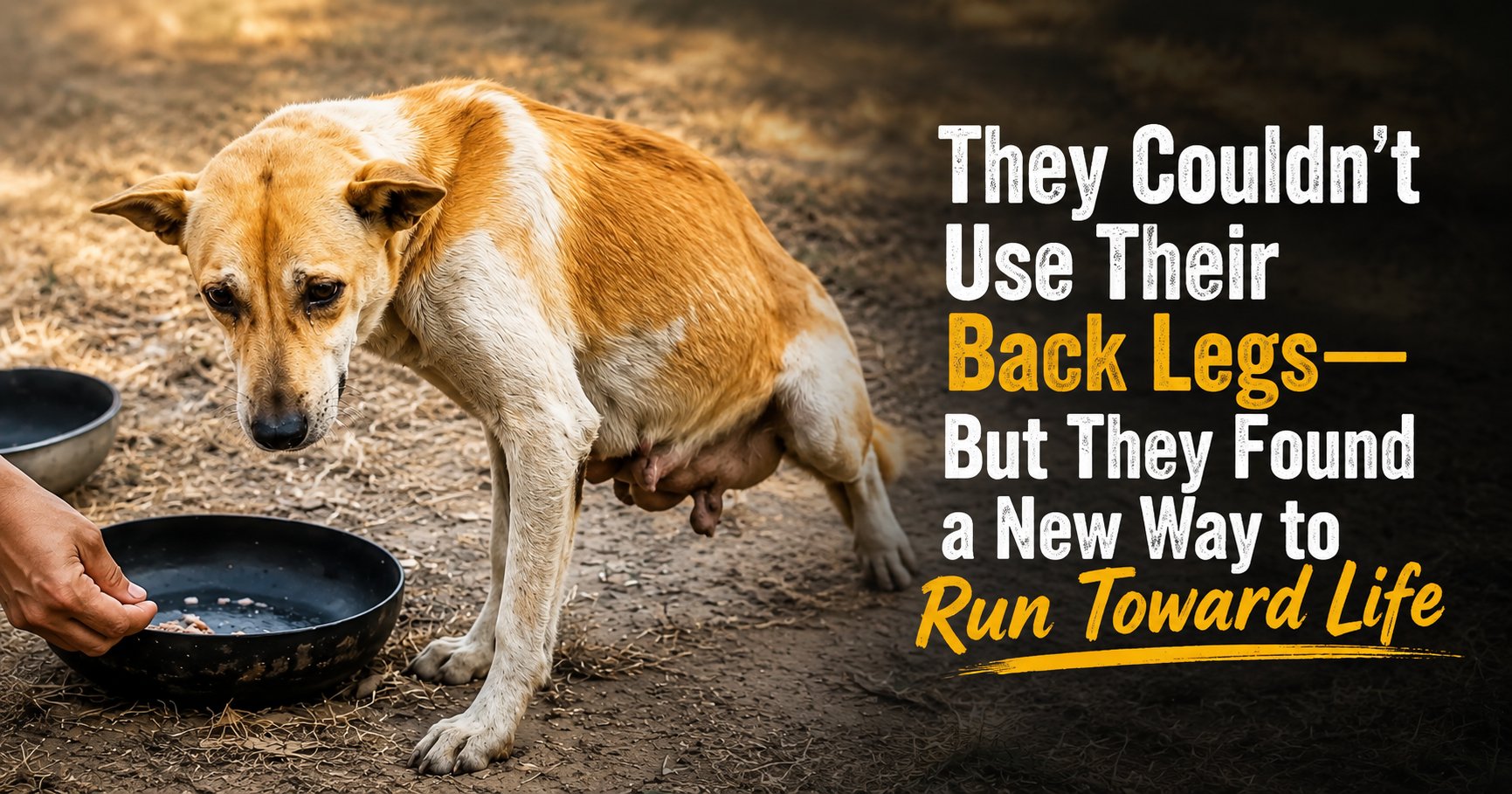
For some dogs, running across a yard is something that happens without thought. For these dogs, even moving a few feet once seemed impossible. Some were born with conditions affecting their hind legs. Others lost mobility after illness, injury, or accidents that permanently changed their bodies. But what happened after they could no longer walk normally is the part of their story that deserves to be remembered.
They did not stop wanting to explore.
They did not stop recognizing the people they loved.
And they certainly did not stop wagging their tails.
With patient caregivers, rehabilitation, and specially fitted dog wheelchairs, many discovered another way forward. The first movements were sometimes awkward and uncertain. Then came a step, the gentle roll of two wheels, and suddenly a world that had seemed unreachable opened again.
Their back legs could no longer carry them.
So love gave them wheels.
WHEN WALKING BECAME A DAILY BATTLE

Every disabled dog has a different story.
Some puppies are born with neurological or orthopedic conditions that affect their ability to use their hind legs. Other dogs experience spinal injuries, accidents, illnesses, or degenerative conditions later in life.
For a dog accustomed to running, losing mobility can transform almost everything about an ordinary day.
Getting to the food bowl becomes harder.
Going outside requires assistance.
Following a favorite person from one room to another may suddenly demand enormous effort.
But dogs often adapt in ways that surprise the people caring for them.
Some learn to move using the strength of their front legs. Others discover new ways to balance. They continue pulling themselves toward familiar voices, toys, food, sunlight, and the people they trust.
Their bodies have changed.
Their desire to participate in life has not.
That distinction matters because a disabled dog is not automatically an unhappy dog. With appropriate veterinary care, pain management, mobility support, and a safe environment, many dogs with limited hind-leg function can continue experiencing meaningful and enjoyable lives.
THE FIRST TIME THE WHEELS BEGAN TO MOVE
For some dogs with hind-leg disabilities, a properly fitted mobility cart can completely change how they interact with the world.
But the first experience is not always dramatic.
A dog may initially freeze after being placed into the harness. Another may attempt a few uncertain steps before stopping. Some need time to understand why wheels are suddenly moving behind them.
That is where patience becomes essential.
Caregivers adjust straps carefully, encourage movement, and allow the dog to learn without unnecessary pressure.
Then comes the moment everyone has been waiting for.
One front paw moves forward.
Then another.
The wheels follow.
And suddenly the dog realizes something extraordinary.
There is somewhere to go.
A few hesitant movements can become a walk across the room. The room can become a yard. And eventually, some dogs begin moving so confidently that the wheelchair stops looking like a limitation and starts looking like exactly what it is: a tool giving them greater independence.
Video: They Couldn’t Use Their Back Legs—But They Found a New Way to Run Toward Life
https://www.youtube.com/watch?v=aSt12LMQAYI
THEY DIDN’T NEED TO WALK LIKE OTHER DOGS TO BE HAPPY
Perhaps the most emotional moments happen when these dogs finally reach something they once struggled to reach.
A favorite toy.
A patch of grass.
Another dog waiting nearby.
Or simply the person they love.
Watch the transformation and it becomes difficult to focus only on the disability. The ears rise. The eyes brighten. The tail begins moving. Some dogs become so excited that their caregivers have to keep up with them.
They are not thinking about what their bodies cannot do.
They are thinking about where they want to go next.
That is what makes stories of dogs in wheelchairs so powerful. The wheelchair does not erase the disability, nor does it “fix” the dog.
The dog was never broken.
The wheels simply provide another way to experience movement, exploration, companionship, and play.
BEHIND EVERY SMALL VICTORY IS SOMEONE WHO REFUSED TO GIVE UP
A dog wheelchair alone is rarely the entire story.
Behind these moments are caregivers doing the quiet work that photographs and videos cannot fully capture.
They monitor the dog’s skin and paws. They clean bedding and equipment. They adjust harnesses. They help with rehabilitation exercises when recommended. They learn when their dog wants to keep moving and when the animal has had enough.
Some days bring enormous progress.
Other days bring frustration.
A dog that confidently crossed the yard yesterday may be tired today. Equipment may need another adjustment. A new environment can make an otherwise confident animal nervous.
Good caregivers learn not to measure every dog against the same standard.
For one dog, success may be racing across the grass. For another, success may simply be taking five comfortable steps toward someone they trust.
Both victories matter.
WHEN DISABLED DOGS PLAY TOGETHER, SOMETHING BEAUTIFUL HAPPENS
There is an especially touching sight when several dogs using mobility carts share the same open space.
One may move quickly while another is still learning.
One may immediately investigate every corner.
Another may prefer staying close to a familiar person.
But eventually curiosity takes over.
Wheels begin rolling.
Noses meet.
Tails wag.
And suddenly the space is filled with dogs doing what dogs have always done: meeting friends, investigating interesting smells, seeking affection, and enjoying being alive.
The disability that immediately catches a human observer’s attention becomes far less important once their personalities appear.
One is mischievous.
Another is gentle.
One wants every available toy.
Another simply wants to lie beside somebody and be touched.
They are not “wheelchair dogs” first.
They are dogs.
And that may be one of the most important things their stories teach us.
DISABLED DOGS NEED SUPPORT, NOT PITY
People sometimes see a dog dragging its hind legs or using a wheelchair and immediately feel sadness.
Compassion is understandable, but pity does not tell the whole story.
A dog’s quality of life depends on many factors, including whether pain can be controlled, whether medical needs are properly managed, and whether the animal can still eat, rest, interact, explore, and enjoy activities safely.
Mobility is only one part of that picture.
A dog that cannot walk normally may still become wildly excited when dinner is prepared. It may still demand belly rubs, bark at visitors, steal a favorite toy, enjoy sunshine, and fall asleep peacefully beside the person it trusts most.
A different body does not automatically mean a life without happiness.
For some disabled dogs, the right veterinary care and mobility assistance can make those ordinary pleasures possible again.
THEIR WHEELS DID NOT CREATE THEIR COURAGE
It is tempting to look at these dogs and say their wheelchairs gave them their lives back.
But perhaps that is not quite right.
The determination was already there.
It was there when they dragged themselves toward a familiar voice.
It was there when they tried again after falling.
It was there when they greeted their caregivers with the same excitement they had shown before losing mobility.
The wheels simply gave that determination somewhere farther to go.
And once they learned how to use them, something beautiful became impossible to miss:
Their legs may have stopped carrying them, but their hearts never stopped running toward everything they loved.
They do not need us to feel sorry for them.
They need appropriate medical care.
They need patience.
They need safe homes.
And above all, they need someone willing to believe that a different way of moving can still lead to a life filled with joy.
Leave a Reply