
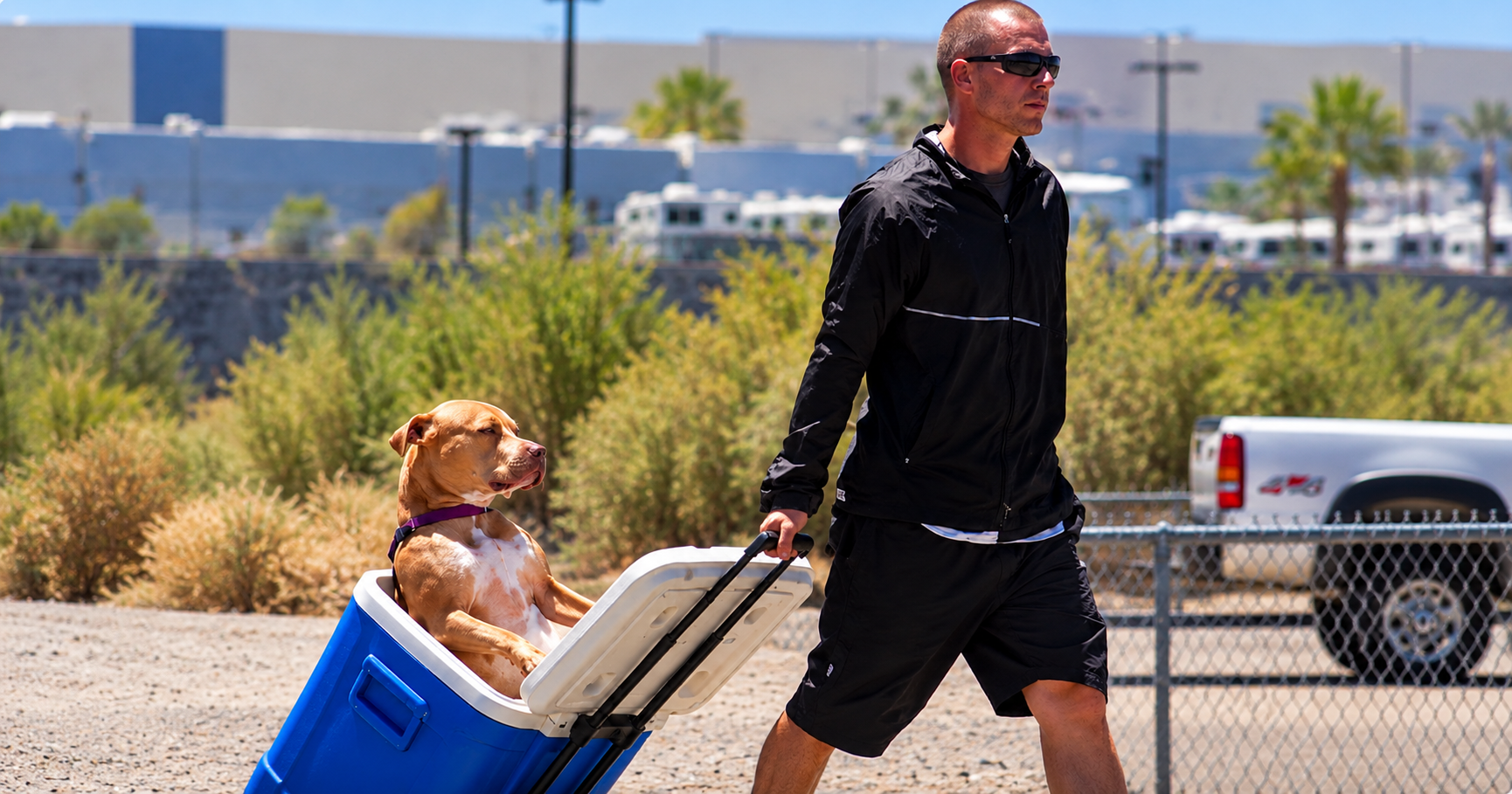
In the brutal summer heat of Bullhead City, Arizona, one dog owner found an unusual way to take care of his four-legged companion.
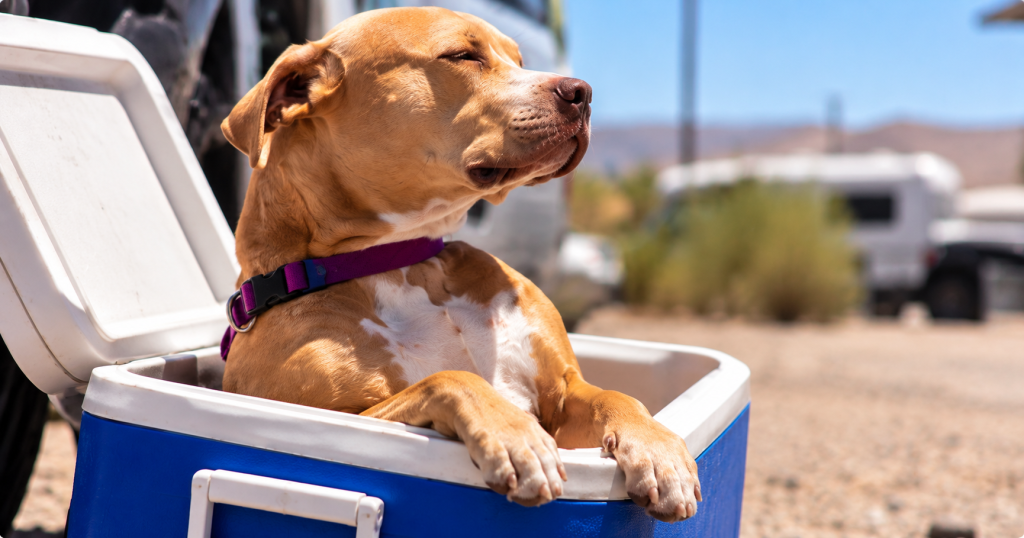
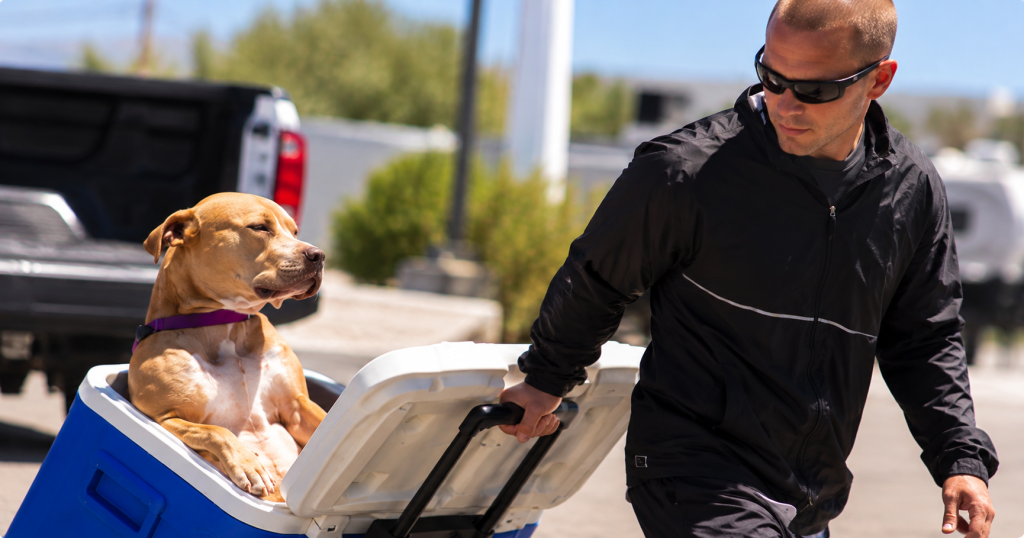
People reportedly noticed a man walking along the sidewalk while pulling a large plastic cooler behind him. But instead of ice and drinks, there was a dog sitting inside.
At first, the scene looked funny.
Then people understood why he was doing it.
The pavement was dangerously hot, and the man didn’t want his dog to burn its paws. So rather than forcing his companion to walk across the scorching surface, he turned a simple rolling cooler into a makeshift ride.
It was an ordinary solution to a serious summer danger, and a reminder that sometimes caring for a dog means noticing the things they cannot tell us themselves.
Why was the dog riding in a cooler?
Reports circulating about the Bullhead City scene say the dog was placed in the wheeled cooler to avoid direct contact with hot pavement. Bullhead City itself warns pet owners that summer heat can be dangerous and specifically recommends avoiding hot pavement and walking dogs during the cooler early-morning or evening hours.
That makes the unusual sight easier to understand.
The dog wasn’t being pushed around simply for entertainment.
The cooler created a barrier between its paws and the hot ground while allowing the animal to accompany its owner outside.
It may have looked strange.
But the reason behind it was remarkably simple: the ground was too hot for his dog to walk on safely.
Hot pavement can seriously hurt a dog’s paws
Many owners judge walking conditions by the air temperature.
That’s a mistake.
On sunny days, pavement can become substantially hotter than the surrounding air. The American Kennel Club cites data showing that when the air temperature reaches approximately 86°F (30°C), asphalt can reach around 135°F (57°C).
That matters because dogs don’t have shoes protecting them.
Their paw pads may be tougher than human skin, but they are not immune to heat. Hot pavement can cause discomfort, blisters and burns, according to AKC veterinary guidance.
And paw injuries aren’t the only concern.
Exposure to extreme heat can also contribute to overheating and heat-related illness, making summer walks something owners need to plan carefully.
A simple cooler became an act of kindness
There was nothing sophisticated about the man’s solution.
No expensive equipment was required.
He simply had a wheeled cooler and a dog he didn’t want walking across dangerously hot pavement.
So the dog got a ride.
That’s part of what made the scene resonate online.
Responsible pet ownership doesn’t always look impressive. Sometimes it means changing a walk because the afternoon is too hot. Sometimes it means choosing grass instead of asphalt. Sometimes it means carrying your dog for a short distance.
And apparently, sometimes it means turning a cooler into a tiny dog carriage.
The method may have been unconventional, but the principle behind it is something every pet owner can understand:
If something could hurt your dog, find another way.
How can you tell if pavement is too hot for your dog?
One practical recommendation from AKC Chief Veterinarian Dr. Jerry Klein is to place your hand comfortably against the pavement for about 10 seconds. If the surface is too hot for your hand, it is too hot for your dog’s paws.
Owners can also reduce risk by walking dogs during cooler parts of the day.
Bullhead City’s Animal Enforcement recommends early morning or evening walks specifically to help prevent burned paw pads.
Grass and shaded areas can also be preferable to sun-baked asphalt. Protective dog boots may provide another option, although dogs generally need time to become comfortable wearing them.
Most importantly, don’t assume a dog will simply refuse to walk when the pavement becomes dangerous.
Dogs depend on their owners to make that decision for them.
Watch for signs that your dog is getting too hot
Hot pavement is only one summer hazard.
Dogs can also become overheated during walks, particularly during intense heat.
According to veterinary guidance cited by AKC, warning signs of heat stress can include excessive panting, restlessness, excessive salivation, nausea, vomiting, seeking shade or becoming reluctant to continue moving. More serious signs can require immediate veterinary attention.
Bullhead City officials similarly advise owners to provide fresh water and shade and to avoid leaving pets in vehicles during hot weather.
The safest walk is sometimes the one postponed until temperatures fall.
His dog didn’t know why it was riding in a cooler
Perhaps the most touching part of the story is also the simplest.
The dog didn’t know anything about pavement temperatures.
It didn’t understand summer safety recommendations.
It didn’t know that people were sharing the unusual sight online.
It simply sat inside while someone it trusted pulled it along.
The owner was the one responsible for noticing the danger.
That’s the quiet contract we make when an animal depends on us.
Dogs give us companionship without asking for much in return. They follow us through ordinary mornings, wait for us to come home and trust us to take them wherever we’re going.
In return, we have to notice when the world becomes unsafe for them.
Sometimes love looks a little strange
To someone passing by, it might have looked ridiculous.
A man walking down the street.
A plastic cooler rolling behind him.
A dog sitting inside.
But once you understand why, the image becomes something different.
It becomes a small example of what responsible pet ownership can look like.
The man didn’t need an elaborate solution. He simply recognized that the pavement could hurt his companion and decided his dog wasn’t going to walk on it.
Love for an animal isn’t always a grand gesture. Sometimes it’s a hot sidewalk, a plastic cooler, and one person quietly deciding: if my best friend can’t safely walk here, I’ll carry the journey for him.
Leave a Reply