

You lean down and kiss your cat gently on the forehead.
To you, the message couldn’t be clearer:
“I love you.”
Your cat looks back at you.
Maybe it closes its eyes. Maybe it starts purring. Maybe it rubs its face against yours.
Or maybe it immediately pulls its head away and looks at you as if you’ve committed a serious personal offense.
That raises a surprisingly interesting question: Does your cat actually understand what a kiss means?
The answer isn’t as simple as yes or no.
Your cat probably doesn’t understand a human kiss the way another human does. But after living with you, it may learn that this strange little ritual predicts something very important.
Affection, safety, attention, and you.
A kiss is a human signal, not a cat signal
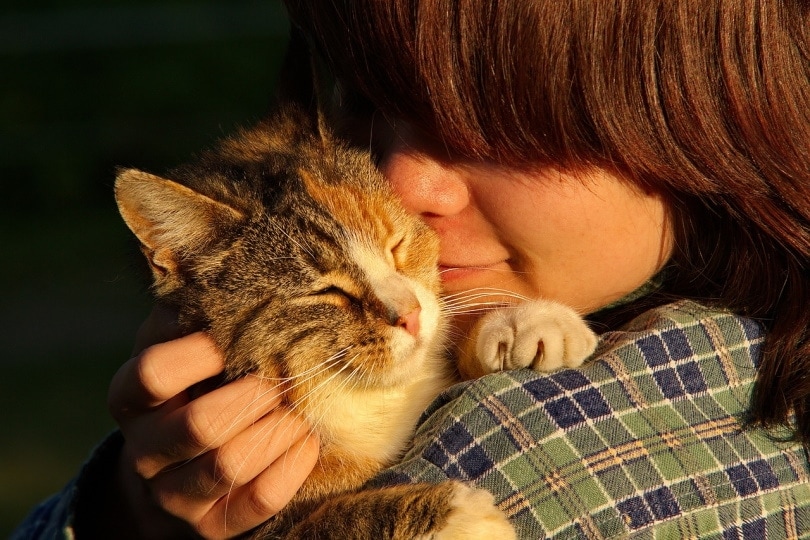
Humans use kissing as a social behavior. Depending on culture and relationship, a kiss can communicate affection, intimacy, comfort or greeting.
Cats don’t naturally communicate with one another by giving human-style kisses.
Their social language works differently.
Cats communicate through body posture, tail position, vocalizations, scent, facial expressions and physical contact. Friendly cats may rub against each other, groom one another, rest close together or touch noses.
So when you kiss your cat’s forehead, your cat isn’t necessarily thinking:
“Ah yes. My human has kissed me. This means love.”
But that doesn’t mean the kiss is meaningless.
Your cat may learn what happens around the kiss.
And that distinction matters.
Your cat may learn what your kisses predict
Imagine something you do every evening.
Your cat jumps onto the couch.
You stroke its head.
You speak softly.
You kiss its forehead.
Then you continue petting it while it relaxes beside you.
Repeat this hundreds of times.
Eventually, the kiss becomes part of a familiar sequence.
Cats are capable of learning associations between events. If your kisses consistently happen during calm, positive interactions, your cat may begin associating that behavior with comfort and attention.
In other words, your cat doesn’t necessarily need to understand the symbolic human meaning of a kiss.
It only needs to learn:
“When my person does this, good things usually happen.”
That’s a very different kind of understanding, but it’s still meaningful.
Your voice may matter as much as the kiss
Think about what happens when you kiss your cat.
You probably don’t approach silently with a completely neutral expression.
You may say its name.
Your voice becomes softer.
Your movements slow down.
Your face comes closer.
You pet its head.
Your cat receives all of these signals together.
Research suggests cats can distinguish familiar human voices and respond differently to speech directed toward them. Cats also learn associations involving familiar people and recurring interactions.
We’ve already explored how much cats may recognize in Does Your Cat Actually Know Its Name, or Just Your Voice?.
So what feels like one simple kiss to you may actually be an entire package of information to your cat:
Your voice.
Your scent.
Your touch.
Your posture.
Your routine.
And what usually happens next.
Your scent is part of the experience too
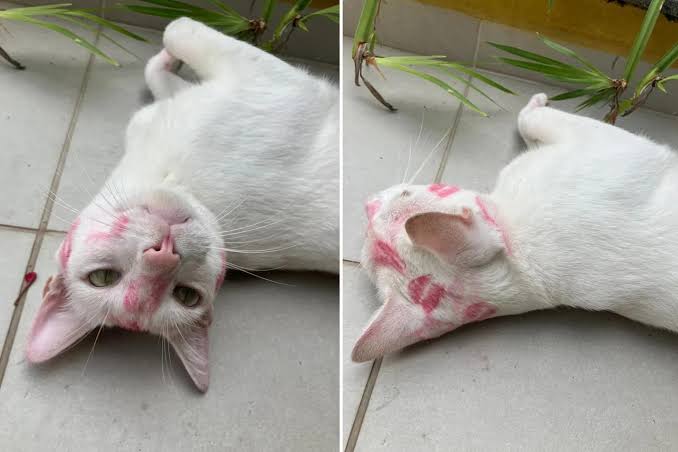
Cats experience their social world through smell far more intensely than humans do.
When your face moves close to your cat, you’re bringing one of the most familiar scents in its environment directly toward it.
That familiar scent matters.
Your smell is already present throughout your cat’s home, particularly on your bedding, furniture and clothes.
It’s one reason your worn shirt can become an unusually appealing sleeping spot.
If you’ve ever wondered why your cat chooses your laundry instead of the expensive bed you bought, read Why Does Your Cat Sleep on Your Clothes When You’re Not Home?.
Your cat isn’t necessarily thinking about your scent sentimentally.
But familiar odor can be an important part of how it recognizes and navigates its environment.
So when you kiss your cat, the interaction isn’t only about your lips touching its fur.
To your cat, you are an entire collection of familiar sensory signals.
Does your cat know you’re showing affection?
This is where we need to be careful.
We can’t ask a cat what it believes a kiss means.
And there isn’t evidence showing that cats understand the abstract human concept behind kissing exactly as we do.
What we can say is that cats can learn from repeated interactions.
If kisses repeatedly occur alongside gentle petting, soft speech, relaxation and positive attention, your cat may learn that the behavior is safe and pleasant.
The distinction is subtle but important.
Your cat may not understand:
“A kiss symbolizes love.”
It may understand something closer to:
“This thing my human does happens when we’re relaxed together.”
For the relationship itself, that may be enough.
How can you tell if your cat likes being kissed?
Don’t judge your cat’s reaction based on what you hope it feels.
Watch its body language.
A relaxed cat may remain close to you, lean into contact, rub against you, purr, settle beside you or slowly blink.
But remember that purring alone isn’t a perfect happiness detector. Cats can purr in different contexts.
Look at the whole animal.
Is its body loose and relaxed?
Does it voluntarily stay near you?
Does it come back for more contact?
Those signals are more informative than one behavior alone.
And sometimes the clearest answer is incredibly simple:
Your cat doesn’t move away.
Some cats genuinely don’t like kisses
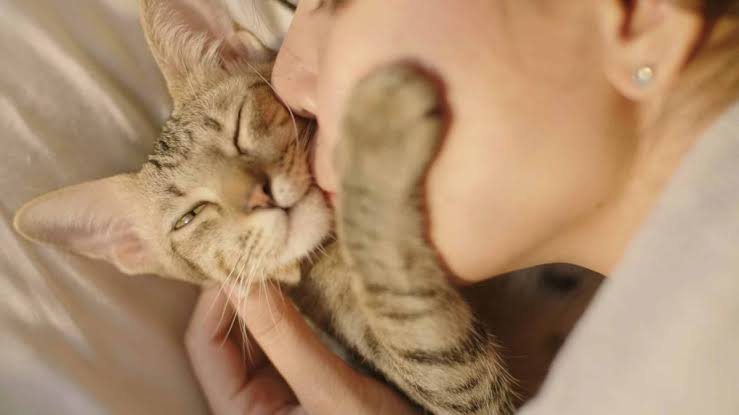
This is equally important.
Not every cat enjoys having a human face suddenly appear inches from its own.
From the cat’s perspective, you are enormous.
Now imagine that enormous creature lowering its head directly toward your face.
For a confident, highly socialized cat that trusts its owner, this may be completely normal.
For another cat, it can feel intrusive.
Signs that your cat wants space may include turning its head away, flattening or rotating its ears, rapidly flicking its tail, tensing its body, moving away, swatting, growling or hissing.
If your cat consistently reacts this way, don’t keep kissing it in an attempt to make it “understand.”
Respect the boundary.
Affection only works when the recipient is comfortable with it.
What does a cat’s version of “I love you” look like?
Cats don’t need human kisses to show social attachment.
Your cat may express comfort and affiliation by choosing to stay near you.
It may rub its face against you.
Follow you into another room.
Sleep beside you.
Approach with its tail upright.
Slowly blink while looking at you.
Or simply settle nearby while you’re doing absolutely nothing.
These behaviors may seem small, but cats often communicate through subtle choices.
Consider sleeping.
A sleeping animal is vulnerable. Choosing a particular resting location can therefore tell you something about where a cat feels comfortable.
That’s one reason a sudden change in sleeping behavior can be so noticeable. We’ve explored Why Does Your Cat Suddenly Sleep Next to You When It Usually Sleeps Alone?.
Your cat climbing into bed with you doesn’t translate literally to “I love you.”
But voluntarily choosing close proximity can still be meaningful.
What about the famous slow blink?
If humans have kissing, cats may have something that feels surprisingly close in emotional effect: the slow blink.
You look at your cat.
Your cat’s eyes partially close.
It slowly blinks.
You slowly blink back.
Research has found that slow-blink interactions can influence cat-human communication, with cats showing more positive approaches following certain slow-blink interactions.
It’s tempting to call this a “cat kiss.”
That’s cute, but scientifically it’s better not to claim the two behaviors mean exactly the same thing.
A slow blink isn’t literally a feline kiss.
But relaxed eye narrowing and blinking can occur during comfortable social interactions.
And unlike leaning your entire face toward a nervous cat, a slow blink gives the animal plenty of personal space.
Try it sometime.
You may be surprised by the response.
Does your cat miss your kisses when you’re gone?
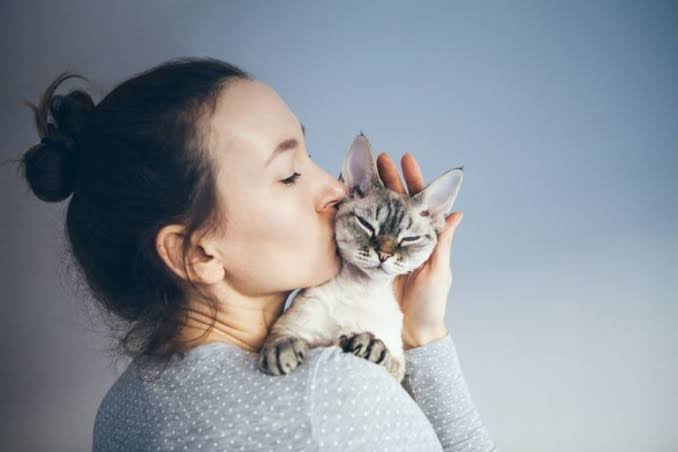
Now the question becomes even more interesting.
If your kisses have become part of a familiar daily routine, what happens when you disappear for several hours?
Your cat’s environment changes.
Your voice is gone.
Your movements are gone.
Your interactions are gone.
Yet your scent remains on furniture, bedding and clothing.
We’ve explored this more deeply in Does Your Cat Miss You When You Leave, Even If It Acts Like It Doesn’t Care?.
We shouldn’t assume a cat sits at home consciously longing for a forehead kiss.
But cats can notice changes in routine and the absence of familiar social interactions.
Your daily affection is part of that routine.
Your cat may understand more than you think, just differently
Perhaps we’re asking the wrong question.
Instead of:
“Does my cat understand that a kiss means I love you?”
Try asking:
“Has my cat learned what my kiss means when it comes from me?”
Those aren’t quite the same thing.
Your cat doesn’t need a human concept of romance or symbolic affection to learn that your face approaching gently is followed by a familiar voice, soft touch and safe interaction.
Over months and years, those repeated moments become part of the relationship.
Your cat learns your habits.
Your sounds.
Your scent.
Your touch.
Your routines.
Maybe even the ridiculous voice you swear you don’t use when talking to it.
And somewhere inside all those repeated interactions, your kiss may acquire a meaning of its own.
Not necessarily “I love you” in human language.
Something simpler.
This is my person.
I know what happens next.
I’m safe here.
Leave a Reply