

For months, maybe even years, your cat has had its own sleeping routine.
The couch. The foot of the bed. A chair by the window. That cardboard box you still haven’t been allowed to throw away.
Then one night, something changes.
Your cat climbs onto the bed, settles beside you and falls asleep.
The next night, it happens again.
And again.
Suddenly, the cat that always preferred sleeping alone wants to be right next to you.
It can feel surprisingly emotional. You may even wonder whether your cat has finally decided it loves you more.
But when a cat suddenly changes where it sleeps, there can be several explanations. Some are wonderfully simple. Others deserve a little more attention.
Your cat may simply have discovered that you’re warm
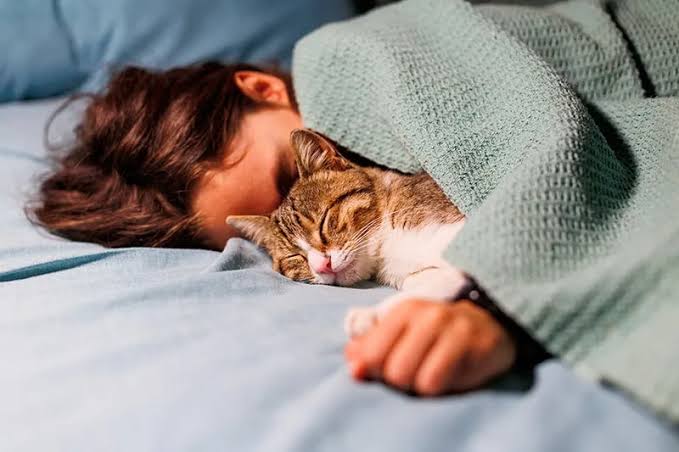
Before turning this into a feline declaration of eternal love, consider the most practical explanation:
You are warm.
Cats naturally seek comfortable temperatures, and a sleeping human produces a steady source of body heat for hours.
Your bed also contains blankets, pillows and soft surfaces that retain warmth.
This can explain why some cats suddenly become much more interested in sleeping beside their owners when the weather gets colder.
Think about when the behavior started.
Did temperatures recently drop?
Did you turn on the air conditioning?
Did your cat lose access to another warm sleeping spot?
Did you move its favorite bed?
Sometimes a mysterious change in cat behavior has a very ordinary explanation.
Your cat may adore you.
But it may also adore your body temperature.
Fortunately, the two aren’t mutually exclusive.
Sleeping beside you requires trust
Sleep makes an animal vulnerable.
A sleeping cat is less prepared to respond immediately to changes in its surroundings. Cats therefore tend to choose sleeping locations where they feel comfortable enough to relax.
That makes one part of this behavior particularly meaningful.
If your cat repeatedly chooses to sleep beside you, your presence probably isn’t making it feel threatened.
Quite the opposite.
Your bed may have become part of a familiar, predictable environment.
Your smell is there.
Your routine is predictable.
Your movements are familiar.
And for some cats, being close to a trusted caregiver may be part of what makes a location attractive.
That doesn’t mean every cat lying beside a human is consciously thinking, “This person protects me.”
But familiarity and perceived safety can influence where animals choose to rest.
Your relationship with your cat may have changed
Relationships between cats and humans aren’t necessarily fixed.
A newly adopted cat may initially sleep alone because it is still learning about its environment.
Weeks or months pass.
Nothing bad happens.
Food arrives predictably.
The human becomes familiar.
Touch becomes less threatening.
The household routine becomes understandable.
Eventually, the bedroom may stop feeling like someone else’s territory and start feeling like part of the cat’s safe environment.
One night, the cat climbs onto the bed.
This can look sudden to you.
For your cat, however, it may be the result of hundreds of small interactions that slowly built trust.
That’s why a previously distant cat becoming more comfortable sleeping near you can sometimes reflect a developing social relationship.
Cats can form attachments to their caregivers
The stereotype says cats merely tolerate humans as long as we keep filling the food bowl.
Research paints a more complicated picture.
Studies of cat-human relationships have found evidence that cats can form attachment bonds with their caregivers. Individual cats vary considerably, of course, and feline attachment doesn’t always look like the highly visible affection people associate with dogs.
Some cats climb into laps.
Some follow their humans from room to room.
Some rub against them.
Others simply choose to occupy the same space.
For a cat like that, sleeping beside you may be one of its quieter forms of social proximity.
This is also why apparently independent behaviors can be misleading. A cat that seems uninterested during the day may still keep track of you remarkably closely.
Researchers have even found evidence that cats can distinguish their own names from other words, something we explored in Does Your Cat Actually Know Its Name, or Just Your Voice?.
Your cat may be paying more attention than its expression suggests.
Your scent may be part of the attraction
There’s another reason your bed is different from almost every other sleeping place in the house.
It smells intensely familiar.
Your pillow, sheets, blankets and pajamas all carry your scent.
For an animal that relies heavily on smell, this creates a recognizable sensory environment.
You may already have noticed something similar when you’re away from home.
Some cats choose to curl up on clothing their owners have worn, even when softer sleeping spots are available.
We’ve explored why cats sleep on your clothes when you’re not home, and familiar scent is one plausible piece of that behavior.
When you’re actually in the bed, the combination becomes even stronger:
Warmth.
Softness.
Familiar scent.
And a familiar person.
From a cat’s perspective, that’s a pretty competitive sleeping spot.
Your daily routine may have changed
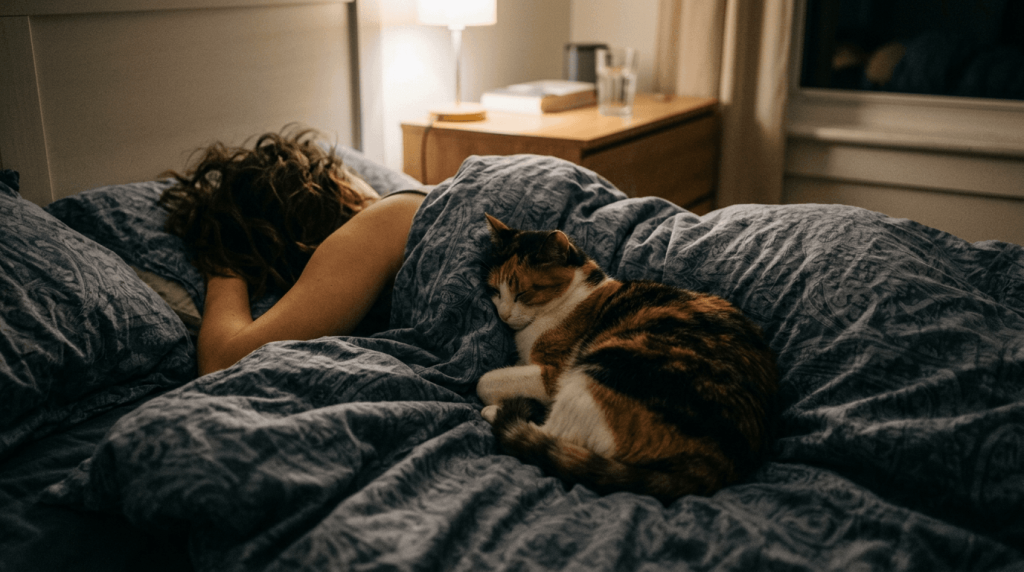
Before asking what changed in your cat, ask what changed in your life.
Maybe you’re going to bed earlier.
Perhaps you’re spending more time at home.
Maybe another family member has changed schedules.
Perhaps furniture has been rearranged.
A door that used to remain open is now closed.
Another pet has taken over your cat’s old sleeping place.
Cats are extremely responsive to environmental routines.
A seemingly insignificant change to you can completely alter the geography of your cat’s day.
If its old sleeping location has become noisier, colder, brighter or less accessible, your bed may suddenly become the better option.
Sometimes your cat hasn’t become clingier at all.
The alternatives simply became less appealing.
Why does your cat sleep against your legs?
Where your cat sleeps can provide additional clues, although there is no universal dictionary translating every feline sleeping position.
The legs and feet are popular locations for practical reasons.
They provide warmth while allowing some distance from a person’s upper body, where movement may be more frequent.
A cat sleeping near your feet may also be able to jump off the bed easily if disturbed.
Other cats prefer the chest, stomach or area beside the head.
These places can be warmer and carry strong familiar scent, but individual preference matters enormously.
The important point isn’t whether your cat chooses your feet or your pillow.
It’s that your cat repeatedly chooses proximity to you when it could sleep somewhere else.
Why does your cat follow you before bedtime?
You walk toward the bedroom.
A few seconds later, you hear paws behind you.
This isn’t necessarily coincidence.
Cats are capable of learning household routines extremely well.
Lights go off.
Doors close.
People brush their teeth.
Phones are plugged in.
Blankets move.
Eventually, everyone becomes quiet.
Repeated night after night, these cues create a predictable sequence.
Your cat can learn that sequence without understanding “bedtime” as an abstract human concept.
It’s similar to another seemingly strange feline habit: following an owner into the bathroom.
What looks like inexplicable cat behavior can often involve curiosity, routine, access and social proximity working together.
Age can change where your cat sleeps
If your cat is getting older, pay closer attention to changes in sleeping behavior.
Senior cats may seek warmer, softer or easier-to-access resting places.
A location that was comfortable several years ago may no longer be ideal.
For example, an older cat may stop sleeping on a high shelf because jumping has become less comfortable. Your bed may suddenly be more attractive, particularly if it is easy to reach.
Older cats may also change their sleeping schedules and activity patterns.
A gradual shift isn’t automatically alarming.
But age makes context especially important.
If a senior cat suddenly becomes much more clingy or dramatically changes where and how it sleeps, look for other behavioral or physical changes too.
Sometimes sudden clinginess deserves attention
This is the part cat owners shouldn’t ignore.
A cat suddenly sleeping beside you is not by itself evidence of illness.
Often, the explanation may be perfectly ordinary.
But a significant behavioral change can sometimes accompany stress, discomfort or a medical problem.
Pay closer attention if the new sleeping behavior appears alongside other changes, such as reduced appetite, increased thirst, weight loss, hiding, unusual vocalization, litter-box changes, difficulty jumping, restlessness, confusion, vomiting, diarrhea or reduced activity.
The combination matters more than the sleeping location alone.
You know your cat’s normal behavior better than anyone else.
If something changes dramatically and persists, particularly when accompanied by other symptoms, contact your veterinarian.
Don’t assume unusual affection is automatically a medical warning.
But don’t assume every sudden behavioral change is “just love” either.
What if your cat suddenly sleeps on top of you?
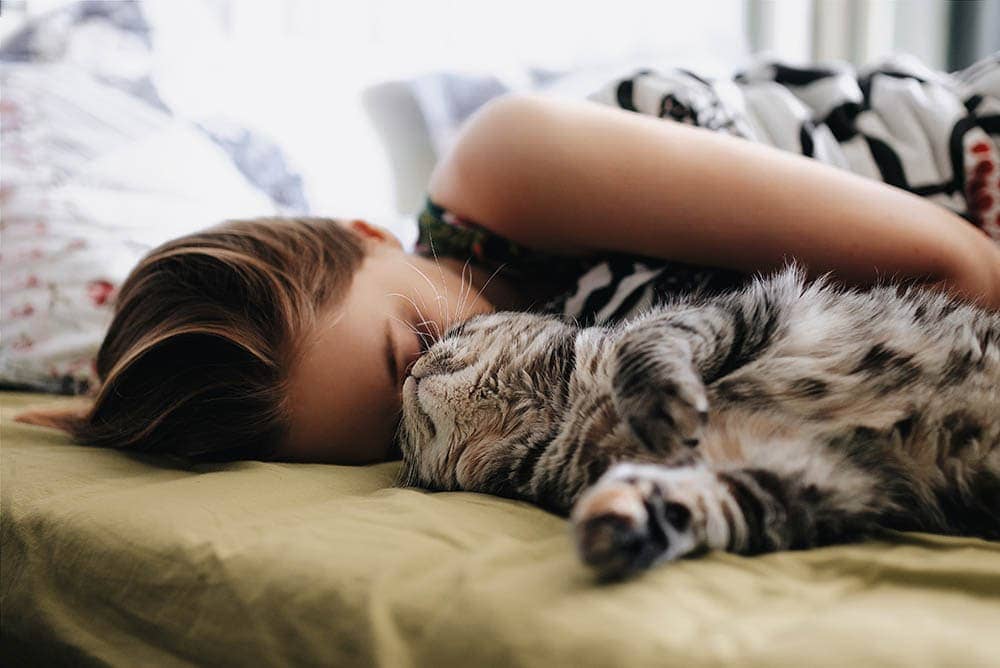
Some cats don’t merely sleep nearby.
They climb directly onto you.
Your stomach becomes a mattress.
Your chest becomes a pillow.
Your legs are no longer legally yours.
Again, several motivations can overlap.
Your body provides warmth and a soft resting surface. Your scent is familiar. Your breathing and movements are predictable.
And if climbing onto you has previously resulted in petting, attention or a comfortable nap, the behavior can also become reinforced.
Cats are very good at discovering which behaviors work.
If lying on your chest produces 20 minutes of uninterrupted chin scratches, your cat has gathered valuable data.
Does your cat know that you love it?
We can’t know exactly how a cat conceptualizes human love.
But cats don’t need a human definition of love to learn that a particular person is associated with safety, food, warmth, play, predictable interactions and gentle physical contact.
That distinction matters.
It’s easy to anthropomorphize pets and imagine complicated human thoughts behind every behavior.
The reality may be simpler, but it isn’t necessarily less meaningful.
Your cat learns you.
Your voice.
Your smell.
Your movements.
Your routines.
The sound of you returning home.
The places you normally sit.
Perhaps even the words you frequently say.
Those repeated experiences become part of the cat’s world.
So why did your cat suddenly choose you?
Maybe winter arrived.
Maybe its old sleeping spot became uncomfortable.
Maybe your routine changed.
Maybe your cat is getting older.
Maybe your relationship has gradually become stronger.
Or perhaps several of those things happened at once.
There is rarely one universal explanation for feline behavior.
But there is something worth noticing.
Your cat has access to the couch.
The floor.
The chair.
The window.
Its bed.
Your clothes.
Probably a cardboard box it considers priceless.
And now, night after night, it walks past all of them and curls up beside you.
Science can’t tell us that this always means “I love you.”
But if your cat feels comfortable enough to fall asleep beside you, your presence has clearly become part of a place where it is willing to rest.
And for an animal that spends so much of its life carefully choosing where it feels comfortable enough to close its eyes, that’s a pretty special place to be.
Leave a Reply