
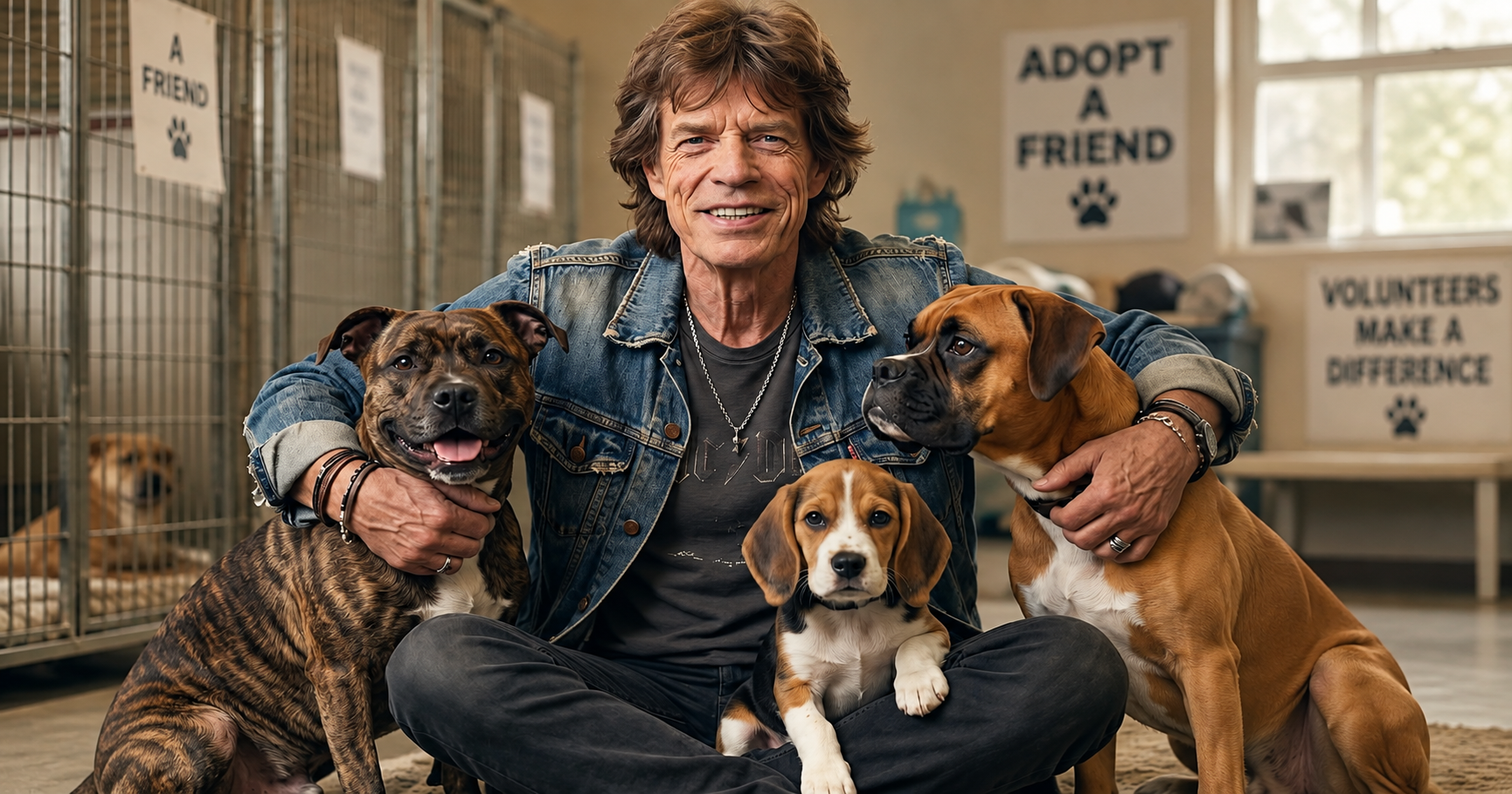
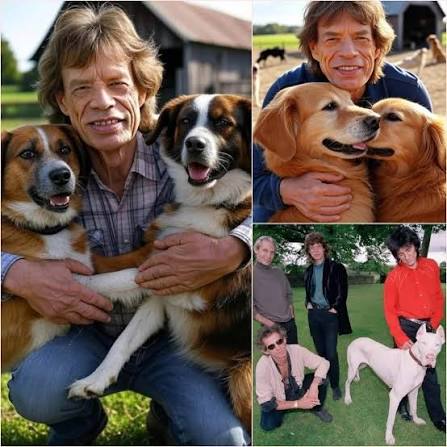
A photograph shows Mick Jagger sitting on the floor of what appears to be an animal shelter.
There are dogs around him. One sits pressed against his side. Another puppy rests between his legs. Behind him, kennel doors and an “Adopt a Friend” sign complete an almost perfect rescue scene.
Then comes the claim that makes the image impossible to ignore:
Mick Jagger reportedly donated $4.5 million to help rescue abandoned dogs at a struggling shelter in Austin, Texas.
It is a beautiful story.
There is only one problem.
At the time of writing, there is no credible evidence confirming that the $4.5 million donation actually happened.
And that makes this story interesting for a very different reason.
The $4.5 million claim sounds extraordinary
The story circulating online follows a familiar emotional pattern.
An animal shelter is supposedly facing a crisis. Dogs are in need of food, medical attention and homes. Then a famous person quietly arrives and provides the money needed to give them another chance.
In this version, that person is Mick Jagger.
The amount attached to the story is enormous: $4.5 million.
If such a donation were made to a public shelter or established rescue organization, it would be a significant philanthropic event. A gift of that size could potentially fund veterinary treatment, staffing, food, foster programs, facility improvements and other animal-welfare services.
Yet searches of credible reporting and official Austin animal-welfare information do not currently provide confirmation that Jagger made this donation.
No verified announcement identifying the recipient shelter has surfaced in the sources checked.
No credible report establishes when the donation supposedly occurred.
And there is no reliable documentation supporting the dramatic “quiet moment inside the shelter” included in versions of the viral story.
Those missing details matter.
Austin really does have animals that need help
The lack of evidence for the Mick Jagger story should not obscure something that is real.
Austin has a substantial shelter population.
Austin Animal Center, operated through Austin Animal Services, serves Austin and unincorporated Travis County. The city’s animal-services information says the shelter commonly has more than 500 animals in need of homes on any given day.
That creates a very different picture from the viral story.
There does not need to be a fictional or unverified celebrity rescue for there to be a genuine animal-welfare issue worth caring about.
Hundreds of animals can need homes at the same time.
Some arrive as strays.
Others may have been surrendered.
Some require medical care.
Others need foster homes or simply enough time and human contact to become comfortable enough for adoption.
For those animals, overcrowding is not a social-media story.
It is their everyday reality.
What could millions of dollars actually do for shelter animals?
This is where the viral claim becomes especially powerful.
Imagine for a moment what a multimillion-dollar contribution really could mean.
Shelters do much more than place bowls of food in front of dogs and wait for someone to adopt them.
Animals may arrive injured, frightened or sick.
They can require examinations, medication, surgery, vaccinations and other veterinary care. Some need behavioral support before they are ready to enter a home. Others need temporary foster placement because the shelter environment itself can be stressful.
Austin Animal Services says donations can support programs involving animal enrichment, post-adoption medical care, behavior training, outreach and veterinary-related needs.
A major donation could therefore have effects that extend far beyond buying food.
It could buy time.
And in animal rescue, time can be extraordinarily valuable.
Time for an injured dog to recover.
Time for a frightened dog to learn to trust people.
Time for a foster family to be found.
Time for the right person to walk through the shelter doors.
That is why a claim involving $4.5 million and homeless dogs feels so emotionally powerful.
But it is also why such a claim deserves verification.
What about the photograph of Mick Jagger with the dogs?
This deserves particular caution.
A realistic-looking image is not evidence that the event depicted actually occurred.
Modern images can be edited, composited, generated or presented without their original context. Even a genuine photograph can be paired with an unrelated caption.
That means we cannot look at a photograph of a celebrity apparently sitting in a shelter and conclude that the accompanying story must be true.
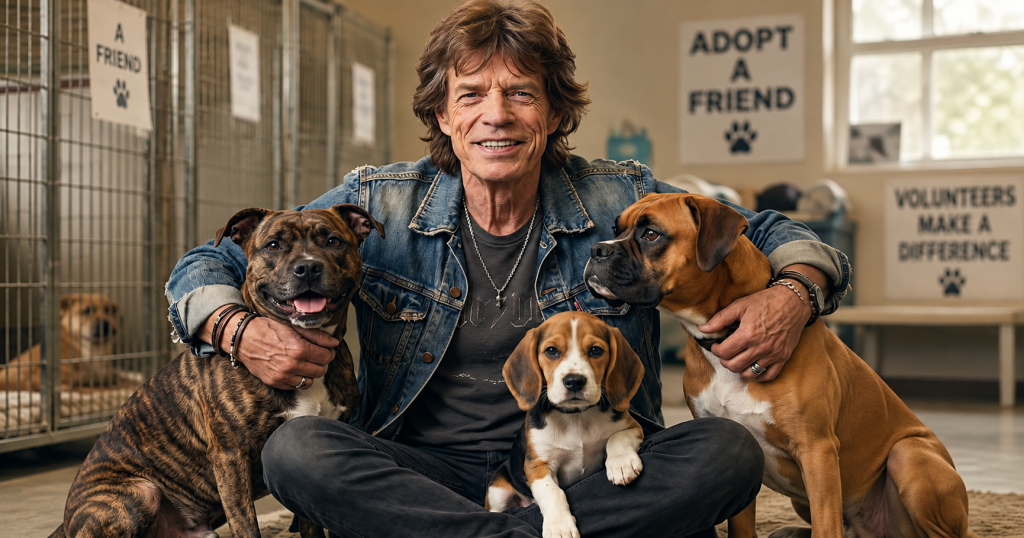
The supplied image depicts a man resembling Mick Jagger surrounded by several dogs in a shelter-like environment. But the image itself does not establish the claimed donation, its amount, its location or the circumstances surrounding it.
Those claims require independent evidence.
This distinction is becoming increasingly important as emotionally persuasive images circulate online faster than the stories behind them can be checked.
Why do stories like this spread so easily?
Because almost everything about this one is designed to make us want it to be true.
Mick Jagger is one of the most recognizable figures in rock history.
Then place him beside abandoned dogs.
Add a struggling shelter.
Add millions of dollars.
Finally, include a mysterious line:
“But one quiet moment inside the shelter is what truly moved everyone.”
Now the reader needs to know what happened next.
It is effective storytelling.
But emotional effectiveness and factual reliability are two different things.
A story can make us cry and still be inaccurate.
A photograph can look completely convincing and still fail to prove its caption.
And thousands of shares cannot turn an unsupported claim into a verified event.
There is a more powerful story hiding underneath the viral one
Imagine removing Mick Jagger from the photograph.
Remove the $4.5 million.
Remove the celebrity name entirely.
There is still a dog sitting inside a shelter somewhere tonight.
Maybe it is twelve years old.
Maybe its muzzle has turned gray.
Maybe it does not jump against the kennel door when visitors arrive.
Maybe the younger dog beside it gets adopted first.
Then another.
And another.
The older dog simply waits.
That animal does not understand why hundreds of people walked past.
It does not know what a celebrity is.
It certainly does not know what $4.5 million means.
Its world is much smaller.
A kennel.
A food bowl.
The sound of footsteps approaching.
And the possibility that one set of those footsteps might finally stop.
Not every rescue requires millions of dollars
Celebrity donations can make headlines, but ordinary people form much of the infrastructure that keeps animal rescue functioning.
One person can foster a dog.
Another can volunteer.
Someone else can donate supplies or money directly through an established organization.
A family can choose an adult shelter dog instead of buying a puppy.
And sometimes simply sharing the profile of an animal needing a home can put that dog in front of the person who eventually adopts it.
None of these actions sounds as spectacular as a multimillion-dollar donation from a rock legend.
But consider the situation from the dog’s perspective.
If you are the animal that finally leaves the shelter, the size of the gesture doesn’t matter.
Your life changed.
The dogs don’t know who is famous
Perhaps that is the part worth remembering.
A shelter dog does not care whether the hand reaching through the kennel belongs to Mick Jagger or someone who works an ordinary job and drove twenty minutes after work to meet a dog they saw online.
It does not understand fame.
It does not understand headlines.
It does not understand whether someone has ten dollars or ten million.
It understands something much simpler.
The kennel door opened.
Someone stayed.
Someone chose it.
And eventually, instead of falling asleep surrounded by the sounds of a shelter, it falls asleep in a home.
So did Mick Jagger really donate $4.5 million?
Based on the credible information available at the time of writing, the claim has not been verified.
That does not prove that no donation of any kind occurred. It means there is currently insufficient reliable evidence to responsibly present this specific $4.5 million Austin shelter story as established fact.
If Mick Jagger, his representatives, the recipient shelter or another reliable source later confirms the donation, the factual picture can be updated accordingly.
Until then, the responsible approach is to distinguish the viral story from what is documented.
And strangely, doing that doesn’t make the underlying animal story less moving.
It makes the real one easier to see.
Somewhere, there are dogs waiting behind shelter doors right now.
They don’t need a famous person to notice them.
They just need someone to notice them.
Sometimes a second chance costs millions.
Sometimes it costs an adoption fee, a drive to the shelter and the willingness to say:
“I’ll take this one home.”
Leave a Reply