
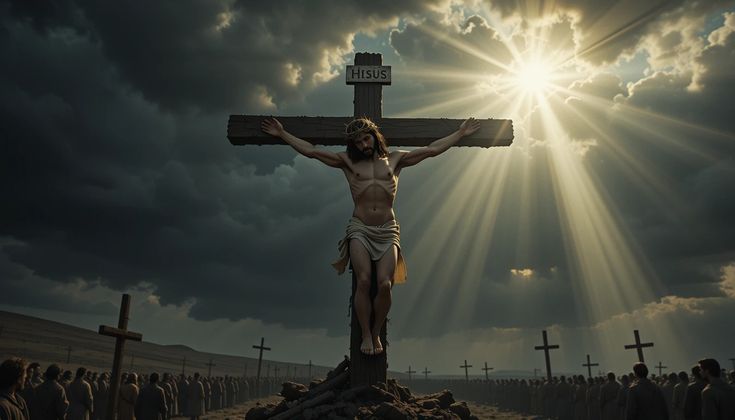
For nearly two thousand years, people have tried to imagine the face of Jesus. In countless Western paintings, films and church images, He appears with long brown hair, a neatly shaped beard, light skin and sometimes light-colored eyes. That image has become so familiar that many people instinctively picture Jesus this way.
But there is a fascinating problem: the Bible never tells us exactly what Jesus looked like, and no authenticated portrait made during His lifetime is known to survive. What we can do is look at His Jewish identity, first-century Galilee, archaeology, ancient art and the world in which He lived. Together, those clues suggest that the historical Jesus probably looked considerably different from many of the famous images created centuries later.
The Gospels Never Describe Jesus’ Face

Perhaps the most surprising place to begin is the Bible itself. Matthew, Mark, Luke and John tell us an enormous amount about Jesus. They describe His teachings, journeys, miracles, relationships with His disciples, arrest, crucifixion and resurrection. Yet they never tell us His height, eye color, skin tone or the precise appearance of His hair.
That absence is remarkable considering how recognizable Jesus would eventually become in Christian art.
The Gospel writers appear to have been far more interested in what Jesus said and did than in preserving His physical features. Even when crowds encountered Him, the narratives generally do not stop to tell readers whether He was unusually handsome, tall or physically distinctive.
This means that whenever we see a detailed portrait claiming to show the “real face of Jesus,” we should be cautious. There is no verified image from His lifetime that allows us to know His exact face.
Jesus Was a Jewish Man From First-Century Galilee
Although we cannot know Jesus’ individual facial features, history does give us an important starting point.
Jesus was Jewish and grew up in Nazareth in Galilee. He therefore would have physically resembled other Jewish men living in the eastern Mediterranean region during the first century rather than the northern European appearance found in many later paintings.
Based on historical and archaeological context, scholars generally consider it likely that Jesus had dark eyes, dark hair and an olive-to-brown complexion typical of people indigenous to that part of the ancient world.
This does not mean archaeology can reconstruct Jesus’ exact face. It cannot tell us precisely how large His nose was, how His eyes were shaped or exactly how dark His skin appeared. Those details disappeared with history.
But it does make one thing clear: the pale-skinned Jesus who became common in European art should not automatically be treated as a literal historical portrait.
His Hair May Have Been Much Shorter Than We Imagine

Long, flowing hair is probably the single most recognizable feature in traditional Western images of Jesus. Yet there is no Gospel passage saying Jesus wore His hair to His shoulders.
Art and other evidence from the Greco-Roman world show many men wearing relatively short hairstyles. Paul’s words in 1 Corinthians 11:14, where he refers negatively to men having long hair, also suggest that very long male hair was not necessarily the ordinary style within the cultural environment of early Christianity.
A beard, however, would not have been unusual for a Jewish man of the period.
So Jesus may indeed have been bearded, but the familiar combination of shoulder-length flowing hair, perfectly symmetrical features and carefully groomed beard comes primarily from later artistic traditions rather than an eyewitness description.
The historical Jesus may have appeared much more ordinary than the majestic figure depicted in Renaissance paintings.
Jesus Probably Looked Like a Man Who Worked and Walked Constantly
There is another clue that paintings sometimes overlook: Jesus lived a physically demanding life.
Mark 6:3 refers to Jesus as a tekton, a Greek word traditionally translated as “carpenter,” although it can more broadly mean a craftsman or builder. Whatever the exact nature of His work, He did not grow up as a wealthy aristocrat living a life of physical comfort.
During His ministry, the Gospels repeatedly describe Jesus traveling between towns and villages. Much of that travel would have been done on foot under the sun of Galilee and Judea.
His clothing would also have reflected the ordinary world around Him. Rather than the immaculate white robes frequently used in religious artwork, Jesus likely wore practical garments typical of Jewish men of His social setting and period.
In other words, the historical Jesus probably looked like someone who worked, walked long distances and lived among ordinary people.
That may actually fit the Gospel story better than the almost royal-looking Jesus found in some later paintings.
Why Did Jesus Eventually Become Light-Skinned With Long Hair in Western Art?

The answer has much more to do with art and culture than historical evidence.
The earliest Christians did not leave behind an authenticated portrait of Jesus. As Christianity spread across different regions, artists gradually represented Him according to their own artistic traditions and cultural environments.
European Christians frequently created a Jesus who looked increasingly European. Elsewhere, Christian communities sometimes portrayed Jesus with characteristics familiar to their own populations. These images were expressions of theology, devotion and culture rather than forensic reconstructions.
Over centuries, certain European representations became enormously influential. The long-haired, bearded Jesus became so widespread that eventually the image itself began to feel historical.
But familiarity is not evidence.
Ironically, this means many famous portraits may tell us more about the cultures that created them than about the actual appearance of the man who walked through Galilee two thousand years ago.
So, What Did Jesus Really Look Like?
The most truthful answer is that nobody living today knows exactly what Jesus’ face looked like.
There is no authenticated portrait from His lifetime, and the Gospels never provide the physical description necessary to reconstruct Him with certainty.
History can only bring us closer.
Jesus was a first-century Jewish man from Galilee. He most likely had dark hair, dark eyes and an olive-to-brown complexion. He probably dressed similarly to ordinary men around Him, and years of physical work and traveling on foot may have given Him a considerably more rugged appearance than many later artistic portraits suggest.
But perhaps the Bible’s silence about His appearance contains something meaningful.
The Gospel writers could have told generations of readers whether Jesus was tall or short, handsome or ordinary, what color His eyes were or exactly how He wore His hair.
They didn’t.
Instead, they remembered how He treated people, what He taught, whom He forgave, the people He touched when others would not, and what happened when He went to the cross.
For nearly 2,000 years, humanity has tried to recreate the face of Jesus.
Yet perhaps the most important thing the earliest Christians wanted us to remember was never His face at all.
Leave a Reply