
You spend the entire evening trying to get your cat’s attention.
You call its name. Nothing.
You sit beside it. It walks away.
You offer the perfect empty spot next to you on the couch. Your cat chooses a cardboard box instead.
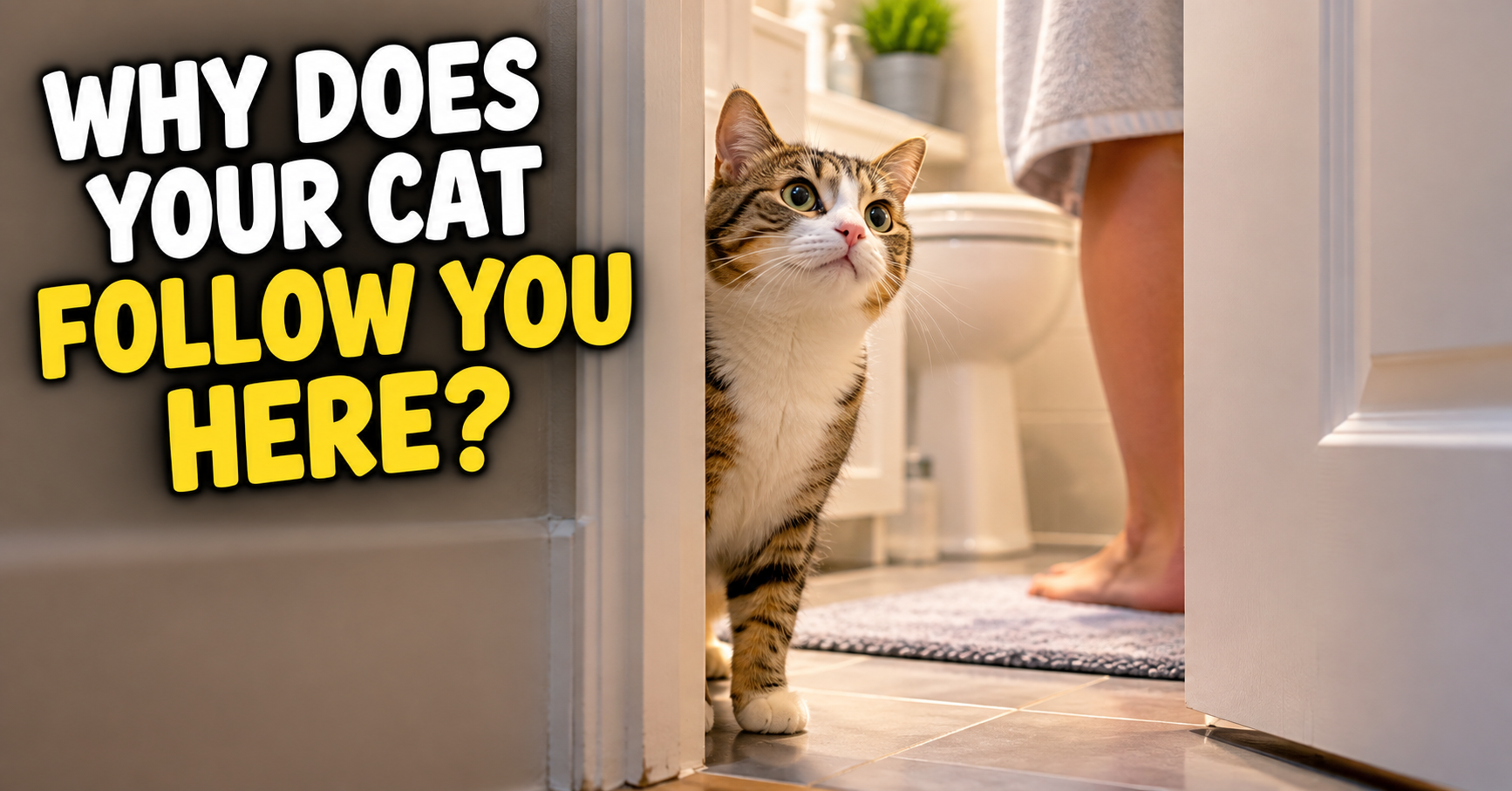
Then you stand up and walk toward the bathroom.
Suddenly, the same animal that acted as though you barely existed is right behind you.
You close the door, and a paw appears underneath it.
What changed?
Why does a cat that seems perfectly happy to ignore you everywhere else suddenly decide that your trip to the bathroom is a two-person activity?
The answer isn’t necessarily one thing. Your bathroom combines several things cats tend to care about: routine, curiosity, territory, predictable attention and, for some cats, their relationship with you.
First, your cat probably isn’t really ignoring you
Cats don’t always display social interest the way humans expect them to.
A dog may run toward you, jump around or follow you visibly from room to room. Cats can be considerably more subtle.
A cat may stay several feet away while still keeping track of where you are. It may rotate its ears when you speak, watch you from another room or appear to be sleeping while remaining aware of your movements.
We recently looked at a perfect example of this in whether cats actually recognize their own names. A cat may hear and recognize something without giving you the dramatic reaction you expect.
So your cat’s apparent indifference doesn’t necessarily mean you have been forgotten.
It may have been monitoring you all along.
The bathroom interrupts your normal movement
Think about what you do around the house.
You walk into the kitchen.
Then the bedroom.
Then the living room.
Then back into the kitchen.
From your cat’s perspective, humans spend much of the day moving through their territory.
But the bathroom is different.
You enter.
You close the door.
And you stay there.
For a naturally curious animal, that can immediately make the room more interesting.
There is now a barrier between your cat and a familiar part of its environment.
And barriers can create curiosity.
The moment a normally accessible room becomes inaccessible, some cats suddenly want to know what’s happening behind that door.
In other words, your bathroom may become fascinating precisely because you tried to keep your cat out of it.
Cats love predictable routines
Your bathroom habits probably feel completely unimportant to you.
To your cat, they can become part of the daily schedule.
You wake up.
You walk toward the bathroom.
You turn on the light.
You brush your teeth.
You take a shower.
Then breakfast happens.
Repeat that sequence hundreds of times and your cat may begin associating one event with another.
The bathroom isn’t simply a room anymore.
It can become part of a predictable chain of events.
And cats are excellent learners of routine.
That’s why some cats seem to appear before feeding time or wait in familiar places at particular moments of the day. They don’t need to understand a clock the way humans do. They can learn recurring patterns and environmental cues.
So when your cat follows you into the bathroom every morning, it may not be thinking about the bathroom at all.
It may be thinking about what usually happens next.
Then there’s the attention problem
There is another possibility that many cat owners overlook.
In the living room, you’re distracted.
You’re watching television.
Looking at your phone.
Cooking.
Cleaning.
Working.
Talking to someone else.
But when you’re sitting in the bathroom?
For a few minutes, you aren’t going anywhere.
From your cat’s perspective, it may have finally found the perfect captive audience.
You might talk to it.
Scratch its head.
Let it rub against your legs.
And because you’re sitting still, your behavior is much more predictable.
If this happens repeatedly, your cat can learn a simple association:
Human goes into bathroom = human becomes available.
Suddenly, following you makes perfect sense.
Your bathroom itself may be interesting
Of course, you might not be the main attraction at all.
Bathrooms contain plenty of things cats find appealing.
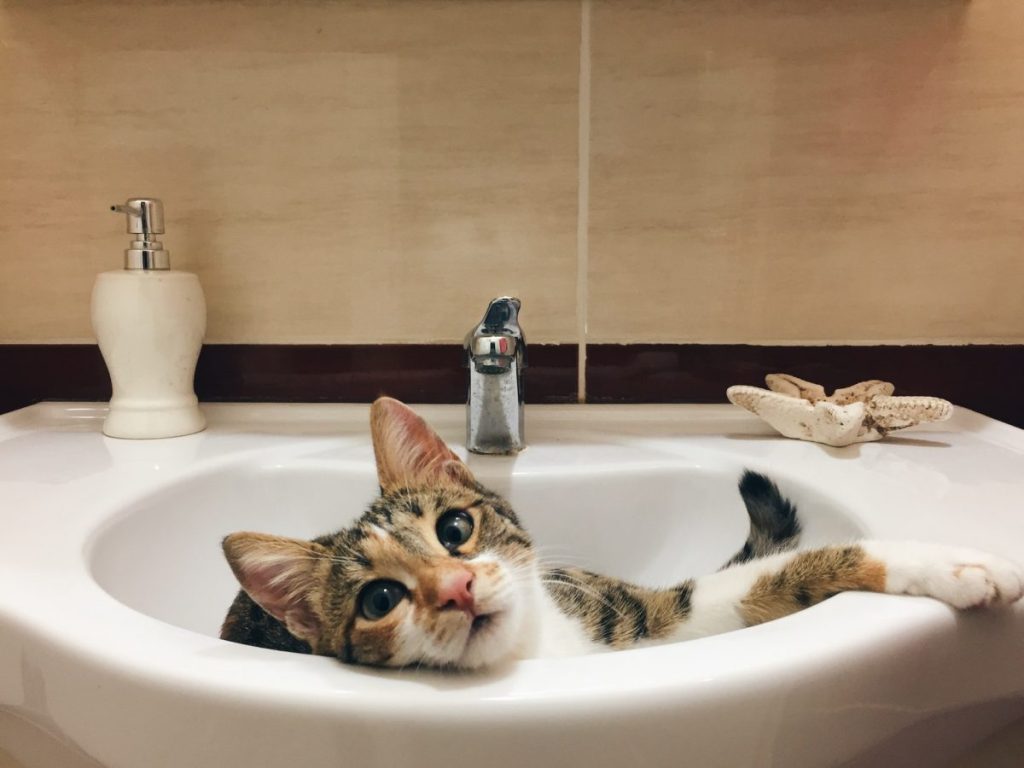
Cool tile can feel comfortable in warm weather. Sinks and bathtubs create interesting shapes to sit in. Faucets can provide moving water. Towels and bath mats offer soft surfaces.
Then there are the smells.
Cats experience their environment heavily through scent. A bathroom contains your scent along with soaps, towels, water and other changing odors.
Even something as ordinary as a dripping faucet can turn the room into entertainment.
So when your cat follows you inside and immediately jumps into the sink, don’t take it personally.
You may simply have provided access to one of the most interesting seats in the house.
Is following you a sign that your cat loves you?
Sometimes, social attachment is likely part of the picture.
Research has provided evidence that cats can form attachment bonds with human caregivers, although feline relationships shouldn’t automatically be interpreted through the same behavioral lens we use for dogs or people.
Some cats simply prefer to remain near their humans.
Not necessarily on them.
Not necessarily touching them.
Just nearby.
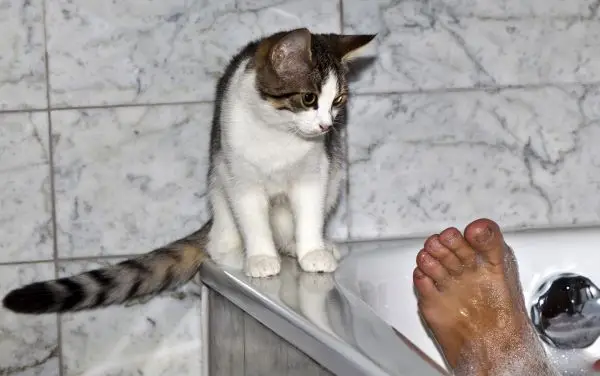
Following you into another room can therefore be part of social proximity.
Your cat may not climb onto your lap every evening, but that doesn’t mean it has no interest in where you are.
For some cats, companionship looks less like cuddling and more like:
“I’m going wherever you’re going, but please don’t make this weird.”
Why does your cat scratch at the closed bathroom door?
This is where the behavior can become especially funny.
Your cat showed absolutely no interest in you five minutes earlier.
You close the bathroom door.
Suddenly:
Scratch.
Scratch.
Scratch.
A paw slides dramatically underneath.
Part of this behavior may simply come from frustration over losing access.
Your home is your cat’s environment too. If doors are normally open, suddenly closing one changes what the cat can explore.
Some cats learn something else as well:
scratching makes humans react.
You speak through the door.
You say the cat’s name.
Eventually, you open it.
From the cat’s perspective, scratching worked.
Repeat that cycle enough times and you’ve accidentally trained your cat to demand bathroom access.
Why does your cat just sit there and stare at you?
This may be the strangest version of all.
Your cat follows you into the bathroom.
It doesn’t want food.
It doesn’t want to play.
It simply sits several feet away and watches.
Cats can stare for many reasons, so a single look shouldn’t be assigned one universal meaning. Your cat may be waiting for interaction, observing what you’re doing, anticipating the next part of your routine or simply occupying a preferred location.
Humans are particularly good at turning animal staring into elaborate stories.
Sometimes the explanation is much simpler.
Pets notice things we overlook, which is also why behaviors such as a dog staring at apparently nothing can seem mysterious until we consider differences in hearing, smell, vision and attention.
Your cat doesn’t necessarily need a mysterious reason to watch you.
You may simply be the most interesting moving object in the room.
What if your cat follows you everywhere, not just the bathroom?
That’s slightly different.
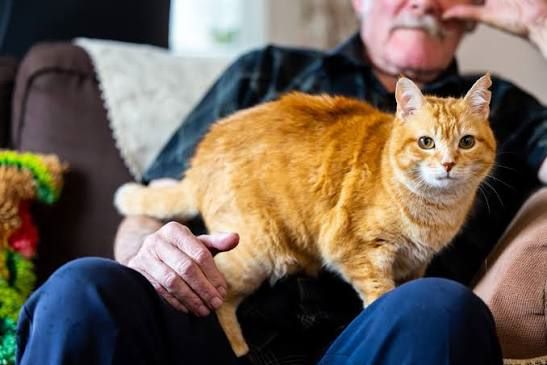
Some cats naturally shadow their owners throughout the house. Personality, social attachment, learned behavior and expectations surrounding food or play can all contribute.
A sudden major change, however, deserves more attention.
If a previously independent cat suddenly becomes unusually clingy and the change is accompanied by altered appetite, vocalization, litter-box habits, hiding, restlessness or other unusual behavior, don’t assume it is simply becoming more affectionate.
Behavioral changes can sometimes accompany stress or health problems.
When something about your cat changes abruptly and persists, discussing it with your veterinarian is sensible.
Should you let your cat follow you into the bathroom?
For most healthy cats, there is nothing inherently concerning about wanting to accompany you.
But bathrooms can contain hazards.
Keep medications, cleaning products and other potentially toxic substances secured. Close toilet lids when appropriate, and don’t allow a cat to drink from a toilet that may contain cleaning chemicals.
Also be careful with small objects such as dental floss and hair ties. Items that seem harmless can become dangerous if swallowed.
Your cat can enjoy supervising your bathroom routine without having unrestricted access to everything inside it.
So why does your cat follow you into the bathroom?
There probably isn’t one universal answer.
For one cat, it’s curiosity.
For another, it’s routine.
For another, it’s the cool floor, running water or chance to receive uninterrupted attention.
And for some cats, being close to their person may genuinely be part of the explanation.
But perhaps the funniest possibility is also the simplest.
Your cat may not actually ignore you everywhere else.
It has been noticing where you are all along.
The bathroom is simply the moment when you finally notice that it’s watching you back.
So tomorrow morning, when you hear little paws behind you and realize you’re about to lose your privacy once again, remember:
You may think you’re going to the bathroom alone. Your cat apparently never agreed to that arrangement.
Leave a Reply