
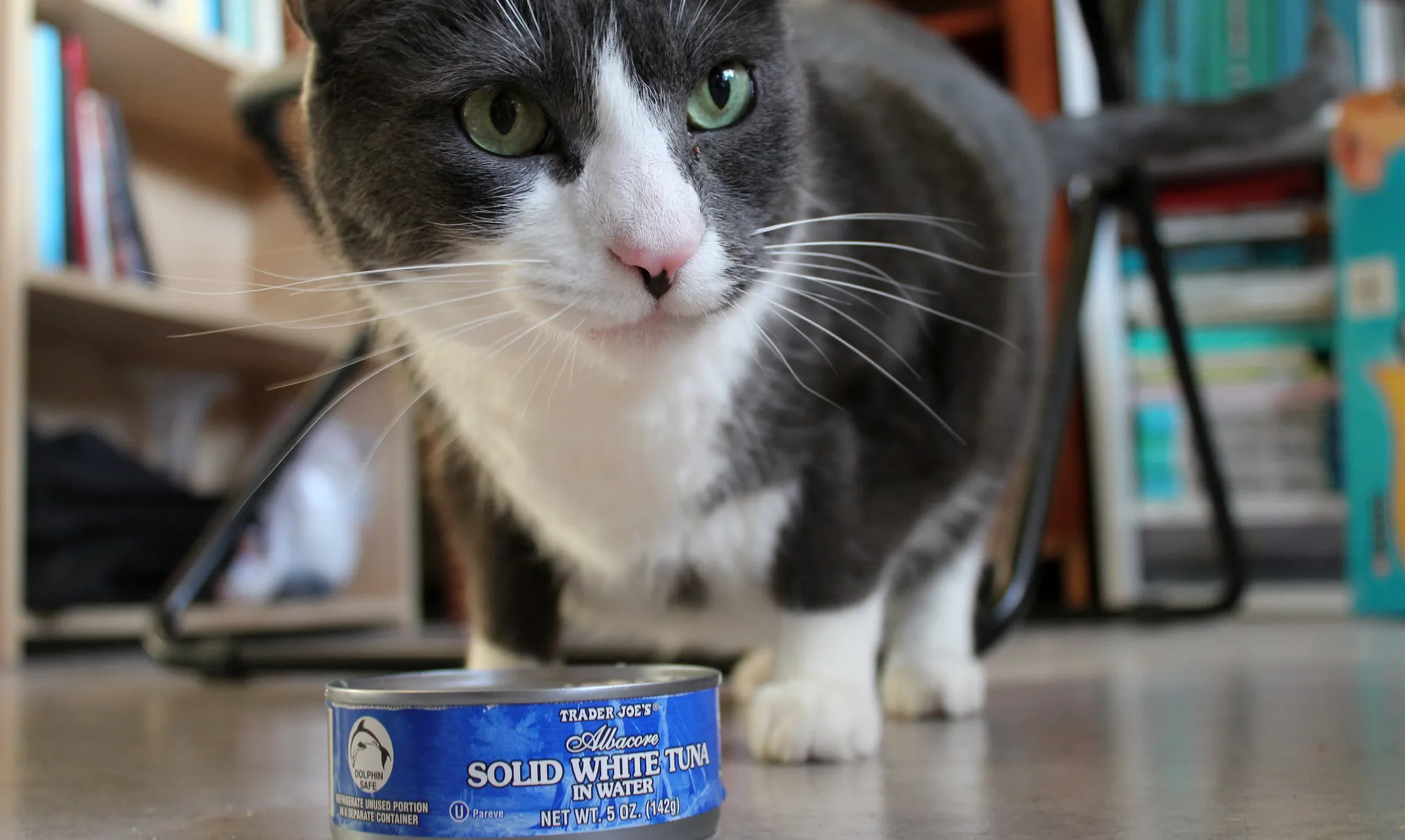
You haven’t even opened the can completely.
Your cat is already in the kitchen.
A few seconds earlier, it was asleep in another room. Now it’s standing beside your feet, staring upward as if the sound of a tuna can being opened activated some secret feline alarm.
For some cats, tuna seems almost irresistible.
They may ignore another treat, walk away from expensive cat food, or pretend not to hear their own name. But open a can of tuna and suddenly you have their complete attention.
So what is it about tuna that cats find so appealing? More importantly, if your cat loves it this much, is it actually safe to keep giving it tuna?
The answer is where this familiar little kitchen ritual becomes much more interesting.
Why do cats love tuna so much?
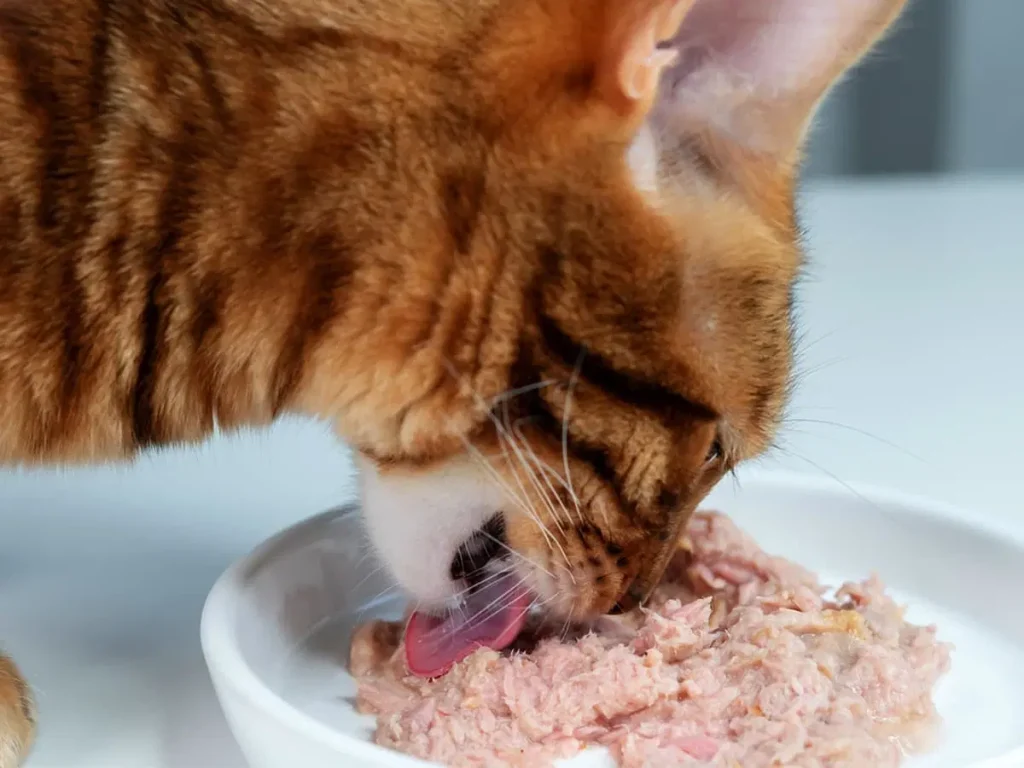
The simplest explanation starts with smell and palatability.
Cats experience food differently from humans, and aroma plays an important role in whether food attracts them. Strong-smelling, protein-rich foods can be particularly appealing. Veterinary guidance for cats with poor appetites even recommends highly palatable, odorous foods in some circumstances because aroma can help encourage eating.
Tuna certainly isn’t subtle.
Open a can and the smell spreads through a room almost immediately. Your cat’s reaction can therefore begin before the food ever reaches its bowl.
There is also the simple fact that many cats apparently enjoy its taste. Veterinary sources note that cats can be strongly attracted to tuna, sometimes enough that owners have to actively limit how much they receive.
But there’s an important distinction:
Something being irresistible to your cat doesn’t automatically make it a nutritionally complete meal.
Can cats eat tuna?
For a healthy adult cat, a small amount of plain, properly prepared tuna can be an occasional treat, according to veterinary guidance from PetMD. It recommends avoiding oils, spices, and seasonings and keeping the serving small.
But tuna intended for humans is different from a complete commercial cat food that happens to contain tuna.
That’s a crucial distinction.
Commercial cat foods are formulated to provide the nutrients cats require in appropriate proportions. VCA notes that complete commercial diets meeting established nutritional standards are formulated to provide essential nutrients such as taurine.
A can of tuna from your kitchen cabinet wasn’t formulated to serve as your cat’s complete diet.
So the better question isn’t simply “Can my cat eat tuna?”
It’s:
“How does tuna fit into my cat’s overall diet?”
Why can too much tuna be bad for cats?
This is where the adorable obsession can become a problem.
Human-grade tuna is not nutritionally balanced as a complete food for cats. Feeding large quantities or allowing it to replace properly formulated cat food can create nutritional imbalances.
PetMD notes several concerns associated with excessive tuna consumption, including excessive calorie intake, mercury exposure, nutritional imbalance, and a condition known as steatitis, which involves inflammation of fatty tissue.
So when your cat looks at you as if it hasn’t eaten in three weeks because you won’t hand over the entire can, remember:
Your cat’s enthusiasm is not nutritional advice.
What about mercury in tuna?
Mercury is another reason not to turn human tuna into an everyday feline meal.
Mercury accumulates in some fish, and tuna can contain meaningful amounts. PetMD specifically identifies mercury exposure as one concern when cats consume excessive tuna and notes that albacore can contain higher mercury levels than some other forms.
This doesn’t mean your cat needs to panic after stealing a tiny piece of plain tuna from your plate.
It means tuna shouldn’t become a major component of the diet simply because your cat loves it.
The difference between an occasional treat and an everyday food matters.
Can cats eat canned tuna?
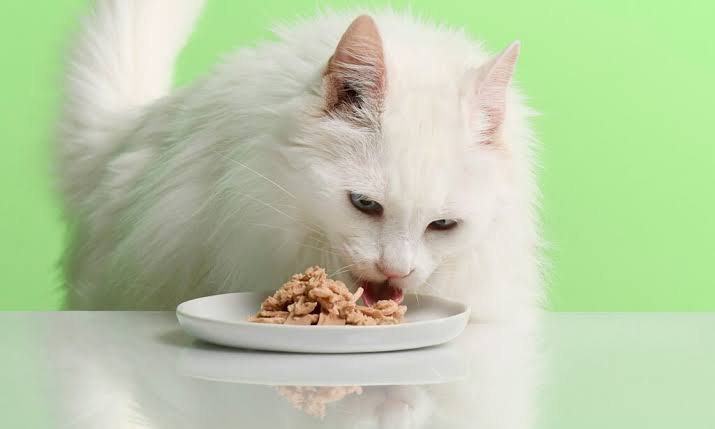
Plain canned tuna packed in water is a more appropriate option for an occasional treat than tuna packed in oil or heavily seasoned varieties. PetMD advises choosing tuna without spices or other flavorings.
That last part is particularly important.
The tuna dish you’re eating may contain ingredients your cat doesn’t need and, depending on the recipe, ingredients that shouldn’t be given to cats at all.
Garlic and onion, for example, can be harmful to cats.
So don’t assume that because the tuna itself can be offered in a small amount, your tuna sandwich, tuna salad, casserole, or seasoned tuna dish is also appropriate.
Plain is the important word.
How much tuna can a cat eat?
There isn’t one perfect portion that applies to every cat. Age, weight, overall diet, medical conditions, and calorie requirements matter.
PetMD’s veterinarian-reviewed guidance gives a specific conservative recommendation for human-grade tuna: no more than about one tablespoon of plain, unseasoned, cooked tuna once a week, while also advising against offering it to kittens under one year old.
If your veterinarian has given your cat a specific diet because of obesity, kidney disease, food allergies, gastrointestinal problems, or another medical condition, follow that plan rather than a general serving guideline.
Most importantly, tuna shouldn’t push nutritionally complete cat food out of your cat’s diet.
Could your cat become obsessed with tuna?
Not “addicted” in the human clinical sense simply because it runs into the kitchen whenever you open a can.
But cats can absolutely learn associations.
Imagine what happens from your cat’s perspective:
Can opens → amazing smell appears → delicious food arrives.
Repeat that sequence often enough and the sound of the can itself can become meaningful.
Your cat may begin appearing before you’ve even touched the tuna.
This is similar to other feline behaviors that seem mysterious until we consider what cats learn from repeated interactions with us. Research suggests cats can even distinguish their own names from other spoken words, something we explore in Does Your Cat Actually Know Its Name, or Just Your Voice?.
Your cat is paying attention to patterns.
Especially delicious ones.
Why does your cat want tuna but reject its regular food?
This can be frustrating.
You put down a nutritionally balanced meal.
Your cat sniffs it.
Walks away.
Then you open tuna for yourself and suddenly the supposedly “not hungry” animal is begging beside you.
Part of the explanation may simply be preference.
Cats can have preferences for particular flavors, aromas, and textures, and veterinary guidance notes that palatability is an important factor in how readily cats eat food.
But repeatedly replacing normal meals with a favorite treat whenever your cat refuses food can create another problem: the cat may learn that waiting sometimes produces something better.
That doesn’t mean you should engage in a battle of wills with a cat that isn’t eating.
A significant or unexplained loss of appetite can be a medical concern.
If your cat suddenly stops eating normally, particularly if there are other symptoms or behavioral changes, contact your veterinarian rather than assuming your cat has simply become picky.
Is tuna-flavored cat food different?
Yes, and this distinction is easy to miss.
Tuna-flavored complete cat food and a can of human tuna are not nutritionally equivalent.
A commercially formulated cat food containing tuna can include the vitamins, minerals, amino acids, and other nutrients required to make the overall diet nutritionally complete.
Human canned tuna isn’t designed to accomplish that.
PetMD similarly distinguishes tuna made specifically for cats from human-grade tuna, noting that cat foods are supplemented to create a more balanced nutritional product.
So don’t assume the word “tuna” on both labels means the products can be used interchangeably.
Can some cats be allergic to fish?
Yes.
Although people often associate food allergies with ingredients such as grains, fish can also be involved in feline food allergies.
Veterinary sources note that some cats can have allergic reactions to fish, including tuna.
If your cat develops persistent itching, skin problems, gastrointestinal symptoms, or other recurring symptoms, don’t try to diagnose a food allergy based on one ingredient yourself.
A veterinarian can help determine whether food is actually responsible and, when appropriate, guide a properly controlled elimination diet.
This is another reason why “my cat loves this food” and “this food is ideal for my cat” aren’t always the same statement.
Can you use tuna to train your cat?
Here’s where your cat’s obsession can occasionally work in your favor.
Food rewards can be useful when teaching animals behaviors, and PetMD specifically notes that suitable human foods can sometimes serve as high-value rewards when teaching cats tricks.
For a cat that finds tuna extremely rewarding, a tiny amount may therefore have motivational value.
For example, rewards can help create positive associations with coming when called, entering a carrier, tolerating certain handling, or learning simple behaviors.
But don’t turn every successful behavior into a spoonful of tuna.
Treat calories still count.
The goal is to use something valuable enough to motivate the cat while keeping the overall diet balanced.
And this reveals something important about living with cats.
They aren’t necessarily impossible to train.
Sometimes humans simply haven’t discovered what that particular cat considers worth working for.
Tuna shouldn’t replace your relationship either
Food is powerful.
Your cat may sprint toward you when you carry its favorite treat, but its relationship with you involves much more than the contents of a bowl.
Cats learn our routines, recognize familiar signals, seek particular resting places, and develop individual ways of interacting with the people around them.
That’s why a cat can appear completely independent and still follow its owner into another room or choose to sleep beside them.
If you’ve ever wondered about that contradiction, read Why Does Your Cat Follow You Into the Bathroom but Ignore You Everywhere Else?.
And if your cat shows affection in ways that don’t always look particularly human, Does Your Cat Understand When You Kiss It? explores how cats may learn the meaning of our affectionate routines.
So should you share your tuna?
For many healthy adult cats, a small amount of plain tuna can be an occasional treat.
But your cat shouldn’t live on the human tuna sitting in your pantry.
Too much can add unnecessary calories, contribute to an unbalanced diet, and increase exposure to mercury. Large amounts over time have also been associated with nutritional problems such as steatitis.
So the next time you pull the tab on a tuna can and hear paws racing toward the kitchen, enjoy the moment.
Your cat isn’t necessarily starving.
It probably isn’t reading the label.
And it certainly isn’t calculating mercury exposure or nutritional balance.
It just knows that one of the most exciting smells in the house has returned.
And somehow, once again, you are the person holding it.
Leave a Reply