
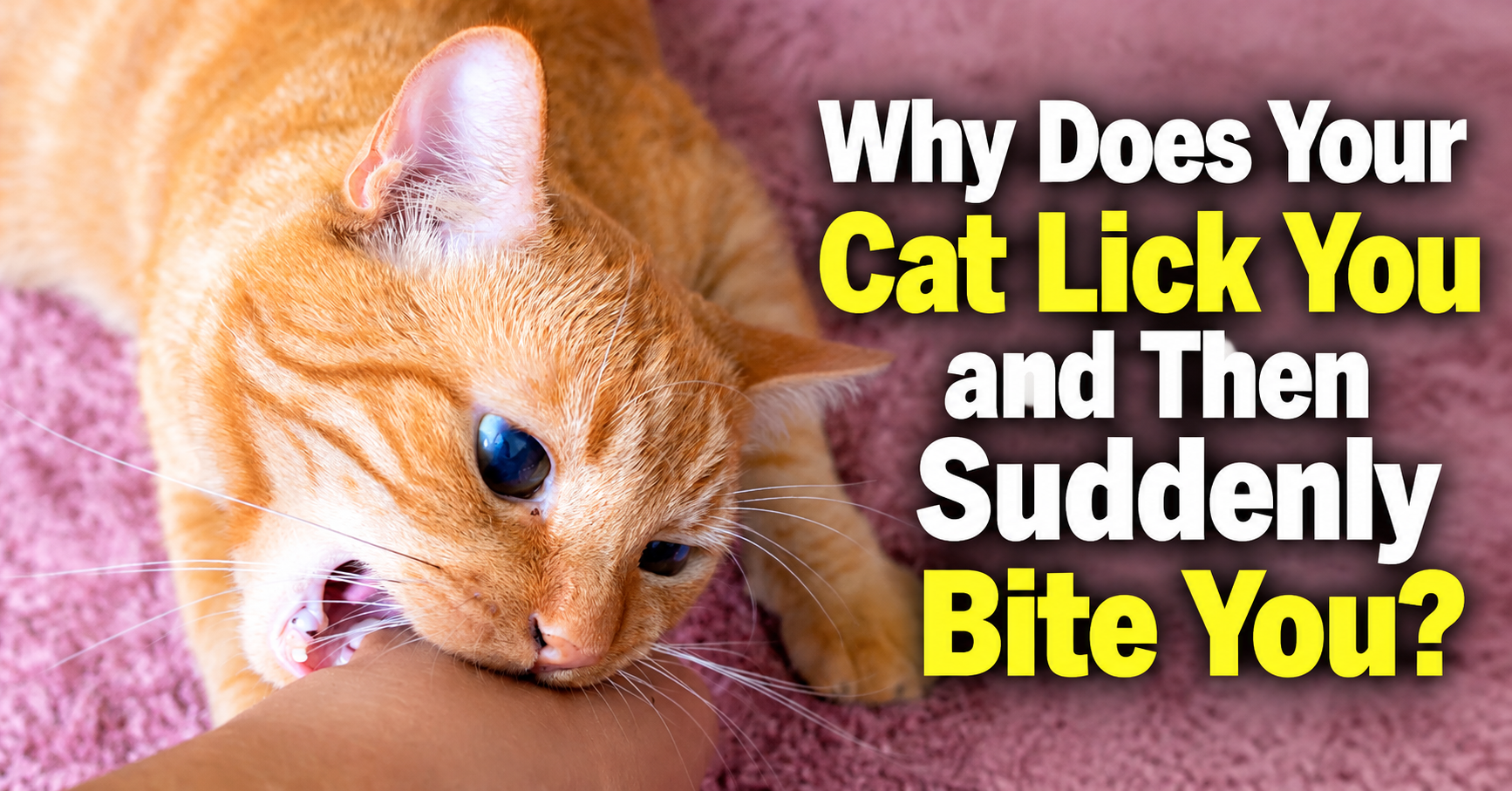
Your cat climbs beside you, settles down, and starts licking your hand.
Everything seems peaceful.
Then suddenly…
Bite.
You pull your hand away and stare at your cat. Thirty seconds ago, it appeared to be showing affection. Now you’re wondering what you did wrong.
For many cat owners, this sequence is confusing because licking and biting seem to send completely opposite messages. One feels affectionate. The other feels like a warning.
But to your cat, they aren’t necessarily contradictory at all.
A cat that licks you and then bites you may be grooming, playing, becoming overstimulated, communicating a boundary, or combining several behaviors in the same interaction.
The secret is usually in what happened immediately before the bite.
Why does your cat lick you in the first place?
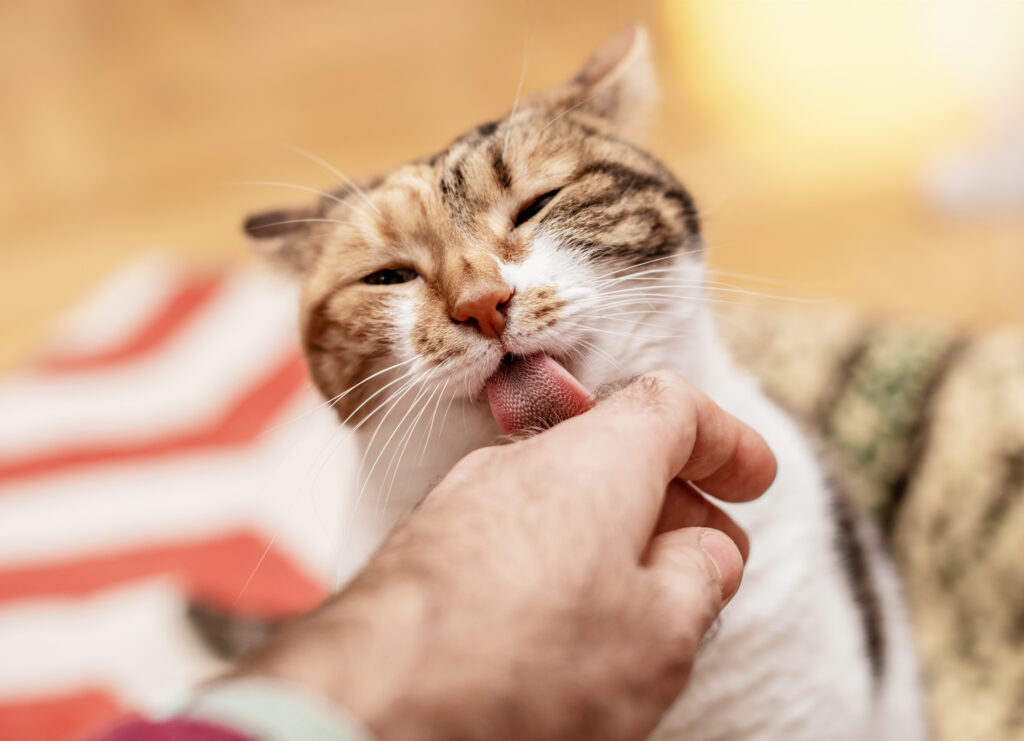
Before understanding the bite, it helps to understand the licking.
Cats spend a significant amount of time grooming themselves, but grooming can also have a social component. Cats that have friendly relationships may groom one another, particularly around areas such as the head and neck.
When your cat licks your skin or hair, social interaction may therefore be part of the explanation.
But don’t automatically translate every lick into “I love you.”
Your skin can also taste interesting. Sweat contains salts, and your hands may carry traces of food, lotions, soaps, or other scents your cat wants to investigate.
Context matters.
A relaxed cat lying beside you and slowly licking your hand is giving you a very different situation from an excited cat grabbing your arm during play.
And sometimes licking is only the beginning of the interaction.
Why does your cat suddenly bite after licking you?
There isn’t one universal explanation.
The bite itself gives you clues.
Was it a gentle nibble that barely applied pressure?
Did your cat immediately release you?
Or was it a hard bite accompanied by flattened ears, a thrashing tail, tense muscles, growling, or an attempt to escape?
Those are very different behaviors.
A soft bite during an otherwise relaxed interaction can occur during grooming or social play. A harder bite after prolonged petting may mean your cat has reached its tolerance limit.
This is why the question isn’t simply:
“Why did my cat bite me?”
A better question is:
“What was my cat doing in the seconds before it bit me?”
Your cat may be grooming you
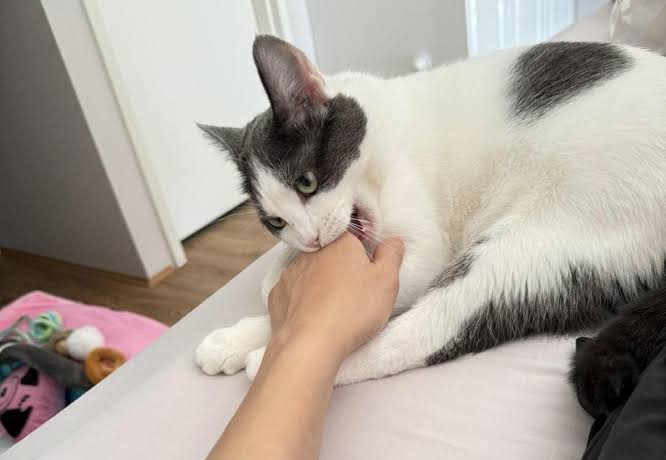
Watch two cats that are comfortable with one another and grooming isn’t always a perfectly gentle sequence of delicate licks.
A cat may lick fur and occasionally use its teeth during grooming.
Your cat obviously knows you aren’t another cat. But some grooming-related behaviors can still appear during interactions with humans.
If your cat is relaxed, voluntarily stays beside you, licks you repeatedly, gives a small controlled nibble, and then resumes licking, the bite may be part of the broader grooming interaction rather than an attempt to hurt you.
Think of it less as an attack and more as your cat using the same toolkit it uses to interact with fur.
Unfortunately, human skin isn’t nearly as well protected.
It could be overstimulation
This is one of the most important explanations.
Your cat may genuinely enjoy being touched and still eventually decide:
That’s enough.
Imagine repeatedly rubbing the same spot on your own skin.
At first, it feels fine.
Keep going long enough and the sensation can become irritating.
Cats can also reach a threshold during physical interaction. A petting session that begins pleasantly may become uncomfortable or overly stimulating.
The confusing part is that the transition can seem instantaneous to humans.
It usually isn’t.
Your cat may have been signaling discomfort before the bite. The signals were simply subtle enough that you missed them.
Watch what your cat does before the bite
Instead of waiting for teeth, watch the rest of your cat’s body.
Possible signs that an interaction is becoming uncomfortable can include a rapidly moving or twitching tail, ears rotating sideways or backward, skin twitching along the back, sudden tension, turning the head toward your hand, enlarged pupils, restlessness, or repeatedly repositioning the body.
Not every one of these signals means a bite is coming.
But combinations and sudden changes matter.
The cat that was completely relaxed two minutes ago may now be telling you:
“I’m finished.”
Stopping before your cat needs to escalate can make physical interactions more comfortable for both of you.
This is one reason understanding subtle feline communication matters so much. Your cat may communicate constantly without using a sound.
Is it a “love bite”?
Cat owners often use the phrase love bite to describe a gentle nibble that occurs during an affectionate interaction.
It’s a cute phrase, but it can also oversimplify what’s happening.
A gentle bite might occur during social grooming, play, excitement, or a transition from enjoyable contact toward overstimulation.
So rather than deciding that every soft bite means your cat loves you, look at the entire interaction.
If your cat’s body remains loose, it stays close voluntarily, and the bite is gentle and controlled, the situation is quite different from a cat that becomes rigid and tries to escape.
Your cat’s body language tells you far more than the nickname we give the behavior.
Your cat may have switched into play mode
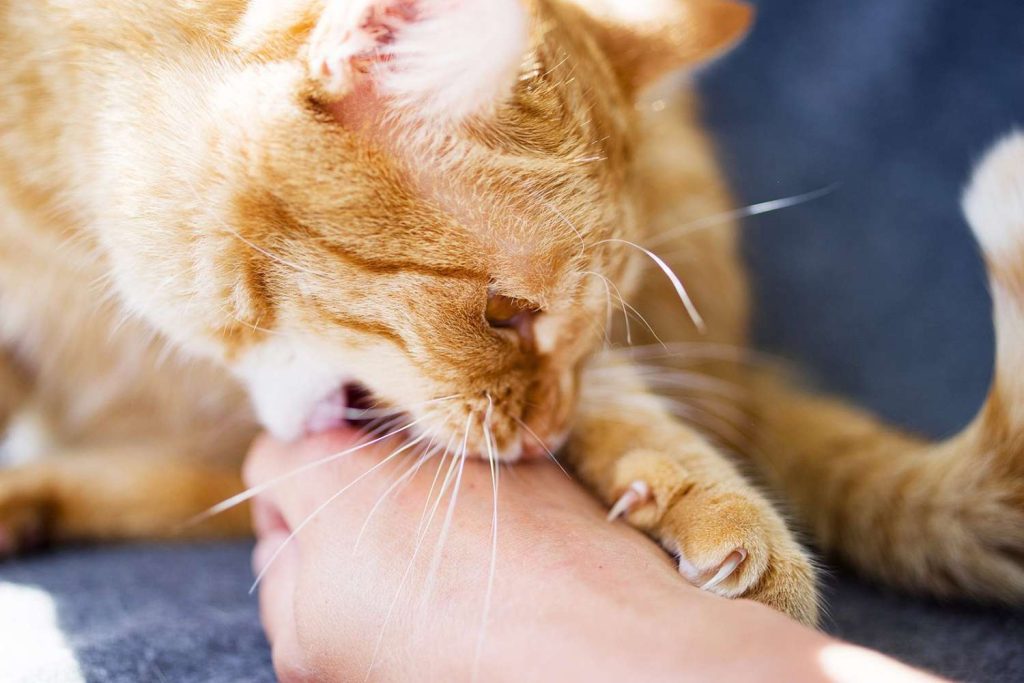
Cats are predators, and play often incorporates behaviors derived from hunting.
Stalking.
Pouncing.
Grabbing.
Kicking.
Biting.
Your moving hand can accidentally become an irresistible target.
This happens especially easily when people regularly use fingers or hands as toys when a cat is young.
The kitten learns:
Hands move. Hands are fun. Hands can be grabbed and bitten.
That behavior becomes much less adorable when the kitten grows into an adult cat with stronger jaws and claws.
If your cat begins grabbing, chasing, or kicking your hand after licking it, the interaction may have shifted from social contact into play.
Redirect that energy toward an appropriate cat toy instead of continuing to wrestle with your hands.
Why does your cat sometimes lick the exact place it just bit?
This can make the behavior even more confusing.
Bite.
Lick.
Bite.
Lick.
From a human perspective, it looks like your cat can’t decide whether it loves you or hates you.
But those aren’t necessarily the choices your cat is making.
Licking and gentle biting can both occur during grooming and social interactions. They can also appear when a cat is excited or transitioning between different behavioral states.
Cats don’t organize their behavior according to the simple human categories of “affection” and “aggression.”
That’s why reading the whole situation is more useful than interpreting one isolated action.
The same principle applies to other confusing feline habits. A cat may appear independent yet constantly want to know where you are. We’ve explored this in Why Does Your Cat Follow You Into the Bathroom?.
Cat behavior often makes more sense when you stop expecting it to follow human social rules.
Why does your cat bite when you stop petting it?
Now we get the opposite problem.
Some cats bite not because you continued petting them, but seemingly because you stopped.
Again, context matters.
The cat may still be excited from the interaction. It may attempt to grab your moving hand as it leaves. It may have learned that grabbing or nibbling causes you to resume attention.
If biting reliably gets a reaction, your reaction itself can become part of the pattern.
That doesn’t mean your cat is manipulating you in a calculated human sense.
It means behavior can be reinforced by what happens afterward.
If a particular action consistently produces attention, movement, play, or another rewarding outcome, your cat may repeat it.
Why does your cat lick and bite you at night?
Nighttime can make the behavior seem even stranger.
You’re lying quietly in bed.
Your cat approaches.
It licks your arm.
Then it nibbles you.
One possibility is simple social interaction. Another is that your cat is awake, stimulated, and ready for activity while you’re trying to sleep.
Cats can become active around times when humans would rather remain motionless.
Your hands or feet moving under blankets can also resemble prey-like movement and trigger play.
But there’s another interesting piece of the puzzle: your cat chose to come near you in the first place.
Cats often choose resting places based on warmth, comfort, familiarity, routine, and security. If your previously independent cat has recently begun climbing into bed with you, read Why Does Your Cat Suddenly Sleep Next to You When It Usually Sleeps Alone?.
The licking and nibbling may simply be another part of that nighttime interaction.
Does licking and biting mean your cat loves you?
It can occur within a positive social relationship, but the behavior alone isn’t proof of love.
This distinction matters.
People naturally want to translate every cat behavior into a sentence:
Purring means “I’m happy.”
Following means “I love you.”
Licking means “You’re family.”
Biting means “I’m angry.”
Real animal behavior is more complicated.
Look instead at the overall relationship.
Does your cat voluntarily approach you?
Does it relax around you?
Does it sleep nearby?
Rub against you?
Seek interaction?
Follow you?
Return after walking away?
Those patterns can tell you much more about your relationship than one lick or one nibble.
The same caution applies when we ask Does Your Cat Understand When You Kiss It?. Cats can learn associations around our affectionate routines without necessarily understanding the symbolic meaning humans attach to them.
Your cat may simply be telling you “enough”
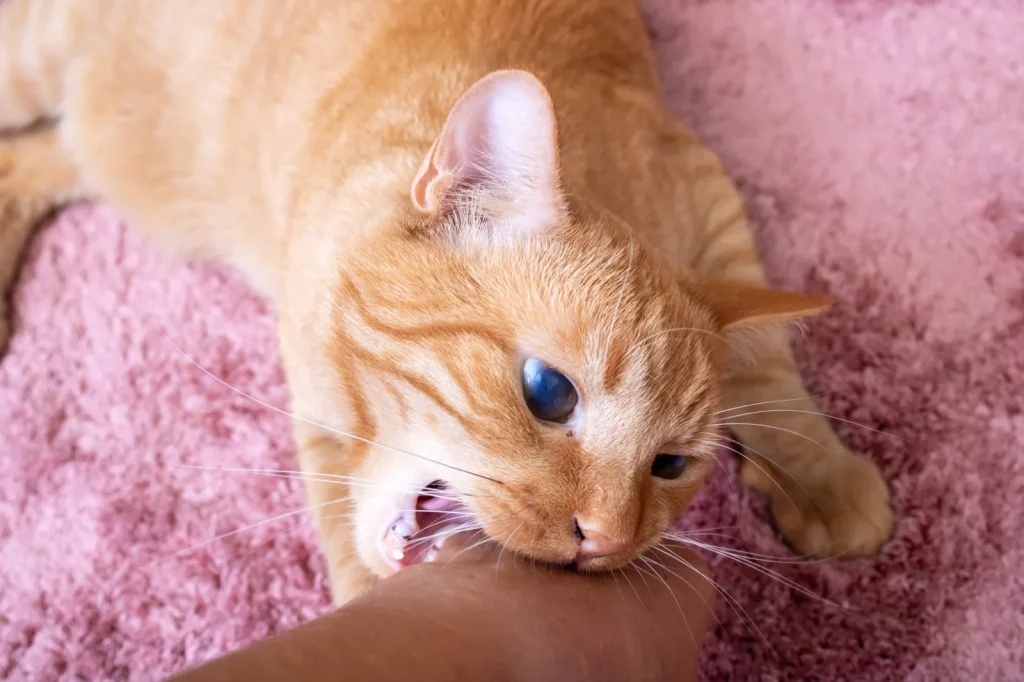
Sometimes the explanation isn’t mysterious at all.
Your cat enjoyed the interaction.
Then it didn’t.
The mistake humans often make is assuming consent to touch is permanent.
Your cat may want ten seconds of petting today and several minutes tomorrow. It may enjoy scratches around its cheeks but dislike repeated touching near its belly, legs, or tail.
Individual preferences vary enormously.
Let your cat participate in the decision.
Pause occasionally during petting.
If your cat moves toward your hand, rubs against you, or clearly seeks more interaction, you can continue.
If it turns away, becomes tense, moves off, or shows signs of irritation, give it space.
You don’t need to wait for the bite to receive the message.
What should you do when your cat bites?
Avoid shouting, hitting, or physically punishing your cat.
Punishment can increase fear and doesn’t teach your cat a better way to interact with you.
Instead, stop the interaction calmly.
If play seems to be driving the behavior, redirect future play toward wand toys, balls, or other appropriate toys rather than hands.
If overstimulation appears to be the trigger, shorten petting sessions and learn the body-language signals that occur before the bite.
And if your cat simply wants space, give it space.
Often the most effective solution is learning to recognize your cat’s threshold before teeth become necessary.
When should sudden biting concern you?
A cat that has always enjoyed being touched but suddenly begins biting deserves closer attention.
Pain can change behavior.
A painful joint, dental problem, skin irritation, injury, or another medical issue may make previously comfortable handling unpleasant.
Be especially attentive if the biting is new or is accompanied by hiding, reduced appetite, unusual vocalization, difficulty jumping, changes in grooming, litter-box changes, or sensitivity around a particular body part.
In those situations, contact your veterinarian rather than assuming your cat has simply become moody.
Sudden behavioral changes can sometimes be one of the earliest signs that something isn’t right.
Your cat may be saying more than you realize
Cats have a reputation for being mysterious, but often the mystery comes from expecting them to communicate like humans.
They don’t.
They communicate through movement, posture, proximity, scent, sound, touch, and patterns we may overlook.
Even when you leave the house, changes in those familiar patterns can matter. That’s part of the question behind Does Your Cat Miss You When You Leave, Even If It Acts Like It Doesn’t Care?.
The lick followed by a bite is another example.
Maybe your cat was grooming you.
Maybe play took over.
Maybe the petting became too intense.
Maybe that gentle nibble was simply part of a relaxed social interaction.
Or maybe your cat had been telling you to stop for the last thirty seconds, and you finally noticed when the teeth arrived.
So the next time your cat calmly licks your hand and suddenly gives you a little bite, don’t immediately ask:
“Does my cat love me or hate me?”
Look at the ears.
Look at the tail.
Look at the body.
Think about what happened just before it.
Because your cat may have been answering the question all along.
You just weren’t reading the language yet.
Leave a Reply