

Your cat has started scratching again.
You check its fur. Nothing obvious. You wash the bedding. The scratching continues. Then comes more licking, a few tiny scabs, perhaps thinning fur around the belly or neck.
The strange part is that the trigger may already be inside your home.
Cats can develop allergic reactions to flea saliva, foods, pollen, mold, dust mites and other environmental substances. Depending on the cause, allergies can affect the skin, digestive system, or respiratory tract. PetMD
And sometimes the culprit is something your cat has encountered for years without any apparent problem.
What does an allergy look like in a cat?
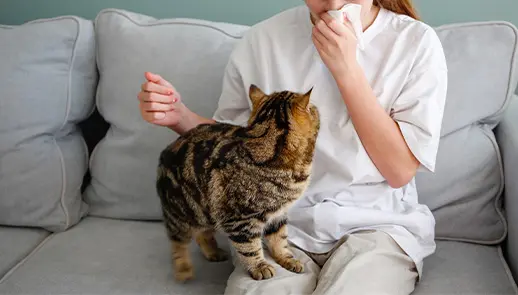
An allergy occurs when the immune system reacts excessively to a substance that would normally be harmless.
In cats, one of the most common clues is itching.
But cats don’t always make itching obvious by dramatically scratching themselves. They may lick and groom excessively instead, eventually creating bald or thinning patches of fur.
Other possible signs include scabs, skin lesions, redness, poor coat condition, vomiting, diarrhea, sneezing, coughing, wheezing, or eye and nasal discharge. PetMD
That’s what makes feline allergies tricky: there isn’t one symptom that tells you exactly what the allergen is.
1. Fleas may be the first suspect, even if you can’t see them
Before blaming your cat’s dinner or your laundry detergent, don’t overlook one of the biggest allergy triggers of all:
fleas.
Flea allergy dermatitis is an allergic reaction to proteins in flea saliva, not simply irritation caused by insects crawling through the fur. Trường Thú y Cornell
And here’s the frustrating part.
You may never see the flea.
Cats are efficient groomers and can remove evidence of fleas from their coats. VCA notes that an allergic cat does not need a major infestation to react; even a single flea bite can cause itching that lasts for days. Vca
Possible clues include intense licking or scratching, small scabs, hair loss and irritation around areas such as the head, neck or base of the tail. Vca
So “I checked and didn’t see any fleas” doesn’t necessarily rule out flea allergy.
2. Dust mites may be sharing your home with your cat
Your cat spends hours sleeping on beds, sofas, carpets and blankets.
Those comfortable places can also harbor microscopic house dust mites.
Dust mites are among the environmental allergens associated with atopic dermatitis in cats, alongside pollen and molds. Unlike some pollens that fluctuate seasonally, house dust mites can potentially create year-round exposure. Vca
That doesn’t mean every itchy cat is allergic to dust mites.
But if symptoms persist indoors throughout the year, environmental allergens may be among the possibilities a veterinarian considers.
3. Mold can be another hidden trigger
Mold and mildew are also recognized environmental allergens for cats. Vca
That makes damp areas of the home worth paying attention to, especially places with poor ventilation or recurring moisture.
The difficult part is that you can’t diagnose a mold allergy simply by finding mold in the house.
A cat can have itchy skin for many reasons, including parasites, infections, food reactions and other environmental allergens. Cornell notes that feline skin disorders often require veterinary investigation because different conditions can produce similar-looking symptoms. Trường Thú y Cornell
So finding a possible trigger isn’t the same as proving it caused the reaction.
4. Pollen doesn’t always stay outdoors

Trees, grasses and weeds can produce pollens capable of triggering environmental allergies.
And closing the front door doesn’t create a pollen-free environment.
Particles can enter through windows and doors and can be carried indoors on clothing and other surfaces. In veterinary dermatology, tree, grass and weed pollens are well-recognized environmental allergens. Vca
Seasonality can sometimes provide a clue.
If itching appears or becomes significantly worse during particular parts of the year, that pattern may help your veterinarian investigate an environmental allergy.
5. Your cat may be allergic to something in its food
This is where many owners immediately blame grain.
But the reality is more interesting.
Food allergy in cats is generally associated with an immune reaction to dietary components, particularly proteins. Veterinary sources commonly identify beef, chicken and fish among reported food allergens. Trường Thú y Cornell
Yes, fish.
The food your cat absolutely loves could potentially be an allergen in an affected animal.
That’s particularly interesting considering how strongly some cats respond to tuna. If yours appears the instant a can opens, read Why Do Cats Go Crazy for Tuna, and Is Too Much Bad for Them?.
But don’t remove foods randomly just because your cat scratches.
Food allergies are only one possible explanation.
Can a cat suddenly become allergic to a food it has eaten for years?
Yes, previous tolerance doesn’t automatically rule out a food allergy.
Cornell notes that food allergies can affect cats of any age and may occur even when a cat has been eating the same diet for years. Trường Thú y Cornell
That can make the problem confusing for owners.
You may think:
“It can’t be the chicken. She’s eaten chicken forever.”
But that history alone isn’t enough to eliminate it as a possibility.
Food-allergic cats commonly develop persistent itching and skin problems, and some also experience gastrointestinal symptoms such as vomiting or diarrhea. Trường Thú y Cornell
What about milk and dairy?

There’s an important distinction here:
Food intolerance and food allergy are not necessarily the same thing.
For example, dairy can cause digestive problems in cats that don’t digest lactose well without necessarily involving an allergic immune response.
This matters because owners often interpret every episode of vomiting or diarrhea after a particular food as an “allergy.”
It isn’t always one.
If you’re unsure which foods from your own kitchen are appropriate in the first place, What Human Foods Can Cats Eat Safely? covers common foods worth knowing before sharing your dinner.
6. Household products can sometimes matter too
Contact allergies are less common, but they can occur.
Potential contact triggers described in veterinary literature include substances associated with topical medications, shampoos, insecticides, cleansers, fibers, dyes, polishes and plants. PetMD
That doesn’t mean ordinary household cleaner is secretly causing every itchy cat’s symptoms.
It means that where symptoms occur and what changed in the cat’s environment can matter.
Did you switch cleaning products?
Use a new shampoo?
Buy new bedding?
Apply a new topical medication?
Those details can be useful when discussing recurring symptoms with your veterinarian.
7. Even your cat’s litter environment may matter
For cats with respiratory sensitivity, airborne irritants deserve attention.
PetMD lists potential triggers associated with allergic bronchitis or feline asthma including cigarette smoke, dusty litter, hairspray, mold, pollen, powders, household chemicals and air fresheners. PetMD
This is different from assuming every sneeze is an allergy.
Respiratory symptoms can have many causes.
But persistent coughing, wheezing or breathing changes should never simply be dismissed as your cat being “sensitive to dust.”
Labored or open-mouth breathing in a cat is an emergency and requires immediate veterinary attention. PetMD
Could your plants be causing the problem?
Plants introduce another important distinction.
A plant can be toxic without being an allergen.
Tulips, for example, pose a toxicity risk to cats if ingested. That’s different from the immune mechanism involved in an allergy.
If you keep flowers around your home, read Are Tulips Toxic to Cats? What Every Cat Owner Should Know.
Separating allergy, intolerance, irritation and poisoning helps you respond appropriately instead of treating them as the same problem.
Signs owners shouldn’t ignore
Repeated scratching is worth paying attention to, but especially watch for a combination of symptoms such as persistent overgrooming, bald patches, recurrent scabs or sores, inflamed skin, vomiting or diarrhea, recurring ear or skin problems, sneezing, coughing or wheezing. PetMD
Constant scratching can also damage the skin and contribute to secondary infections. Cornell notes that food-allergic cats may scratch enough to produce skin wounds vulnerable to bacterial infection. Trường Thú y Cornell
In other words, the original allergy may not remain the only problem.
How do veterinarians figure out what a cat is allergic to?
This is usually detective work rather than one magical test.
Your veterinarian may consider your cat’s history, symptom pattern, physical examination, parasite exposure, diet and environment before choosing appropriate diagnostic steps.
When food allergy is suspected, one of the most useful approaches is a strict elimination diet trial using an appropriate novel or hydrolyzed diet, followed when appropriate by a dietary challenge. Cornell describes dietary trials lasting at least eight to ten weeks, while more recent PetMD veterinary guidance describes an eight-to-12-week trial. Trường Thú y Cornell
And strict means strict.
Random treats and extra foods can interfere with the process.
That’s another reason not to start switching foods repeatedly without a plan.
Don’t assume “grain-free” solves allergies
Because food allergy often gets discussed alongside pet food marketing, owners may assume grain is automatically the problem.
But commonly reported feline food allergens include animal proteins such as beef, chicken and fish, while grain reactions can occur but are not necessarily the leading culprit. PetMD
So buying a food simply because the package says “grain-free” doesn’t diagnose or automatically solve an allergy.
The ingredient your cat reacts to has to be identified properly.
Can treats interfere with an allergy investigation?

Absolutely.
Suppose your veterinarian places your cat on an elimination diet.
The new diet contains none of the suspected proteins.
Everything goes perfectly until someone gives the cat a favorite chicken treat.
Now you’ve potentially reintroduced an ingredient you’re trying to eliminate.
This is particularly relevant if you regularly use food rewards for training. Food can be extremely useful for reinforcing behavior, as explained in Can Food Really Make Your Cat Listen to You More?, but a cat undergoing a veterinary food trial needs rewards compatible with that specific diet.
Health comes before the training snack.
Your cat can’t tell you what’s itching
That’s what makes allergies so frustrating.
Your cat can’t point toward the sofa and say:
“It’s the dust mites.”
It can’t tell you that chicken makes its skin itch.
It can’t explain that one flea bit it three days ago.
Instead, you see the consequences: licking, scratching, bald patches, irritated skin, digestive problems, or respiratory symptoms.
And because so many conditions can produce similar signs, guessing can send you in the wrong direction.
The best clue may not be one dramatic symptom.
It may be a pattern.
When does the itching happen? Where does your cat scratch? Did the diet change? Is it seasonal? Has flea prevention been consistent? Did a new household product appear shortly before the problem started?
Those details can turn an apparently mysterious allergy into something your veterinarian can investigate.
So the next time your cat begins scratching for no obvious reason, don’t assume the culprit must be somewhere outside.
It could already be sharing the house with you.
Leave a Reply