
Your cat is sitting beside you at dinner.
It isn’t meowing. It isn’t touching your plate. It’s simply staring at the piece of chicken in your hand with the kind of concentration only a cat can manage.
Eventually, you give in.
But just before that little piece reaches the floor, a surprisingly important question appears: Can cats actually eat the same foods we do?
The answer is yes, but with a major catch.
Some ordinary human foods can be offered safely to healthy cats in small amounts. Others can cause digestive problems or even serious poisoning. And a food being “natural,” healthy for humans, or eagerly demanded by your cat doesn’t automatically make it appropriate for a feline diet.
Cats are obligate carnivores, meaning their nutritional biology depends heavily on animal-derived nutrients. Their primary food should therefore be a nutritionally complete and balanced cat diet, while human foods are best treated as occasional extras rather than replacements for regular meals.
So before you share what’s on your plate, here’s what you should know.
1. Plain cooked chicken and turkey
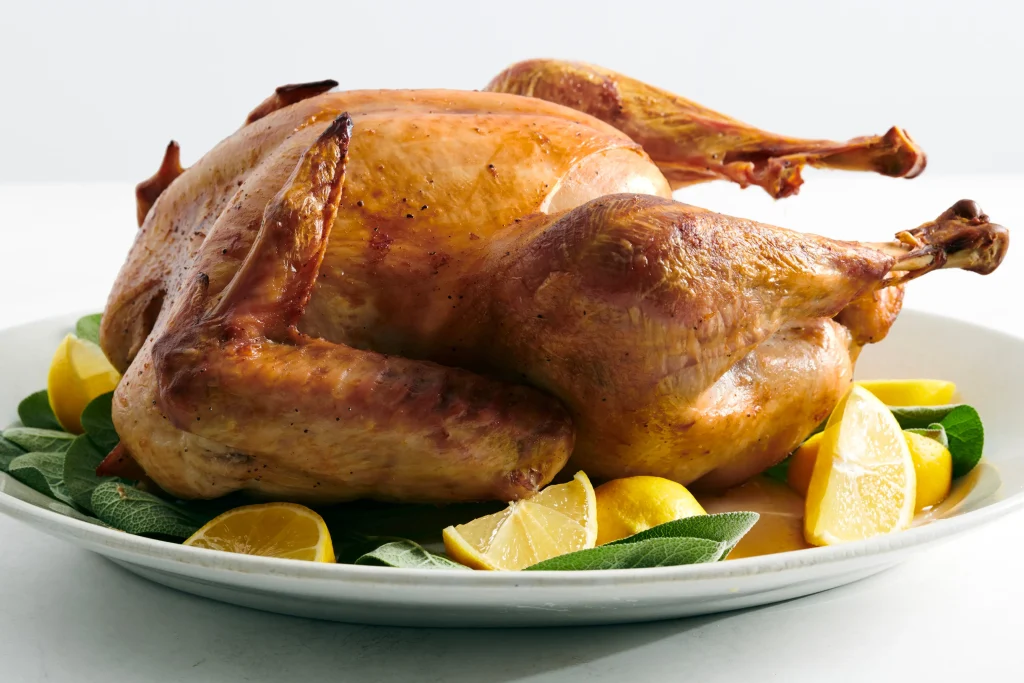
If you’re looking for one of the simplest human foods to share with a healthy cat, plain cooked poultry is a reasonable place to start.
Chicken and turkey provide animal protein, something cats are naturally equipped to use.
But preparation makes all the difference.
The meat should be fully cooked, boneless, skinless, and unseasoned. Avoid butter, sauces, marinades, excessive salt, garlic, onion, and other seasonings.
PetMD recommends cooked chicken and turkey as possible treats for healthy cats, provided they’re prepared plainly and served in small portions.
That means a tiny piece of plain chicken may be fine.
A heavily seasoned piece of chicken from your dinner plate may be a completely different story.
2. Plain cooked beef
Lean, thoroughly cooked beef can also be offered occasionally to many healthy cats.
Again, think plain.
Remove bones and excess fat, cook the meat completely, and don’t add seasoning.
Cats don’t need the steak sauce, garlic butter, pepper, or marinade that makes the meal more interesting to us. PetMD includes lean, fully cooked beef among the human foods that can be used as small treats for healthy cats.
Your cat wants the meat.
It doesn’t need the recipe.
3. Cooked fish
The stereotype of a cat going crazy over fish didn’t appear from nowhere.
Many cats find fish highly palatable, and properly cooked fish can sometimes be offered in small amounts.
Salmon and tuna are common examples. Fish should be fully cooked and served without bones, skin, seasoning, sauces, or added oils.
But this is where owners can make an easy mistake.
If your cat loves tuna, that doesn’t mean human canned tuna should become its regular meal.
We’ve covered this distinction in Why Do Cats Go Crazy for Tuna, and Is Too Much Bad for Them?. Tuna may be incredibly appealing to cats, but human tuna isn’t formulated as a complete feline diet.
A little fish can be a treat.
A nutritionally balanced cat food should remain the foundation.
4. What about eggs?
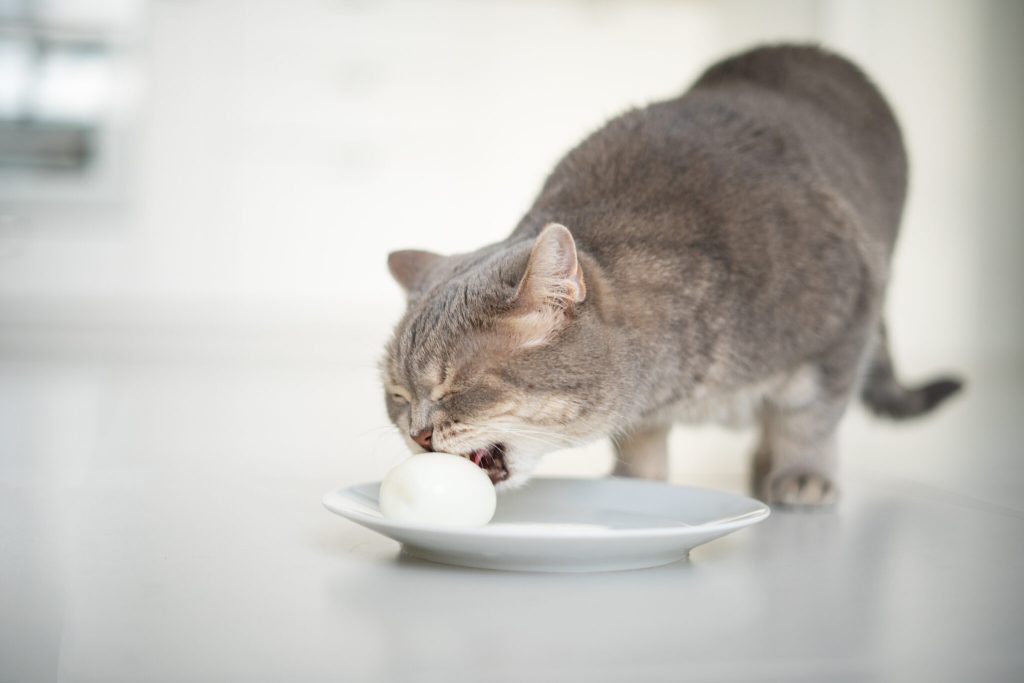
Cooked egg can also be used as an occasional food for some healthy cats.
Eggs provide protein, but that doesn’t mean your cat needs a plate of scrambled eggs for breakfast.
Keep portions small and the preparation simple. Avoid adding butter, salt, cheese, onion, garlic, or other seasonings.
Raw egg is a different issue. Raw animal products can expose cats and people to harmful bacteria, and ASPCA advises against feeding raw or undercooked meat and eggs because of risks including Salmonella and E. coli.
So if you’re sharing egg, cooked and plain is the safer approach.
5. Can cats eat vegetables?
This question surprises some owners because cats don’t require vegetables in the same way humans do.
Remember, cats are obligate carnivores.
That doesn’t mean every vegetable is poisonous, however.
PetMD lists small amounts of certain plainly cooked vegetables, including broccoli, peas, and sweet potato, as possible occasional snacks for healthy cats. But vegetables aren’t nutritionally necessary for cats, and some cats may experience gastrointestinal upset.
If your cat shows absolutely no interest in broccoli, don’t worry.
You don’t need to convince it to finish its vegetables.
6. Can cats eat pumpkin?
Plain pumpkin is another human food commonly discussed in feline nutrition.
Pumpkin contains fiber and is sometimes recommended in specific circumstances involving stool quality.
But there’s an important distinction between plain pumpkin and pumpkin desserts.
Pumpkin pie filling, pumpkin pie, sweetened pumpkin mixtures, and heavily spiced foods aren’t the same thing as plain cooked pumpkin.
If you’re considering pumpkin specifically to address constipation, diarrhea, or another health problem, ask your veterinarian first. Digestive symptoms can have many causes, and adding fiber isn’t automatically the correct treatment.
7. Can cats eat fruit?
Some fruits can be offered to cats in very small quantities, but most cats aren’t particularly interested in sweetness.
That’s because cats lack the same functional sweet taste perception humans have. PetMD notes that certain fruits can be occasional treats, but cats may have difficulty digesting larger amounts and don’t nutritionally need fruit.
This is one of those situations where “safe” doesn’t mean “necessary.”
Your cat can live a perfectly happy life without sharing your fruit bowl.
And some fruits should be avoided altogether, so don’t assume every fruit is automatically harmless.
8. What about cheese and milk?
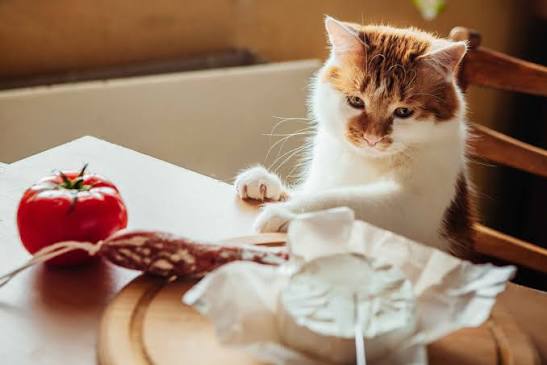
This is where cartoons have misled generations of cat owners.
A bowl of milk beside a happy cat may look completely normal in children’s books, but many adult cats don’t digest lactose well.
ASPCA notes that pets generally don’t have significant amounts of lactase, the enzyme required to break down lactose, so milk and other dairy products can cause diarrhea or other digestive upset.
PetMD similarly advises caution with dairy products in cats.
So if your cat desperately wants your milk, that desire doesn’t prove its digestive system agrees.
9. Human food can also be useful for training
Food isn’t only about feeding.
A tiny amount of something your cat considers particularly delicious can sometimes work as a high-value training reward.
That’s why your cat may ignore you repeatedly until it realizes that responding to a cue leads to something worthwhile.
We explore that process in Can Food Really Make Your Cat Listen to You More?.
The key isn’t simply handing your cat food.
It’s using a safe, tiny reward immediately after the behavior you want to reinforce.
Suddenly, the supposedly “untrainable” cat may become a much more interested student.
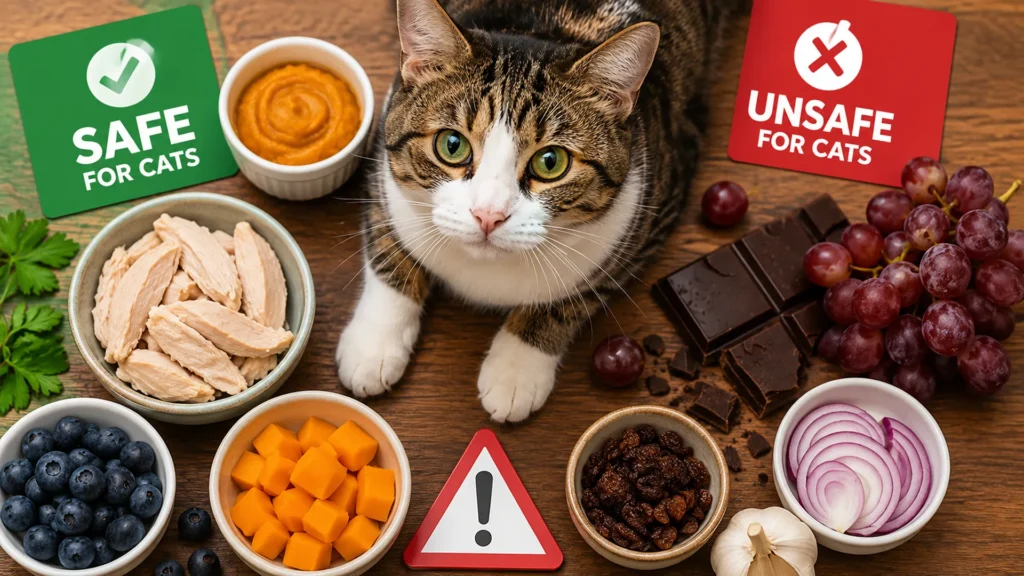
Human foods cats should NOT eat
Knowing what’s safe is only half of the story.
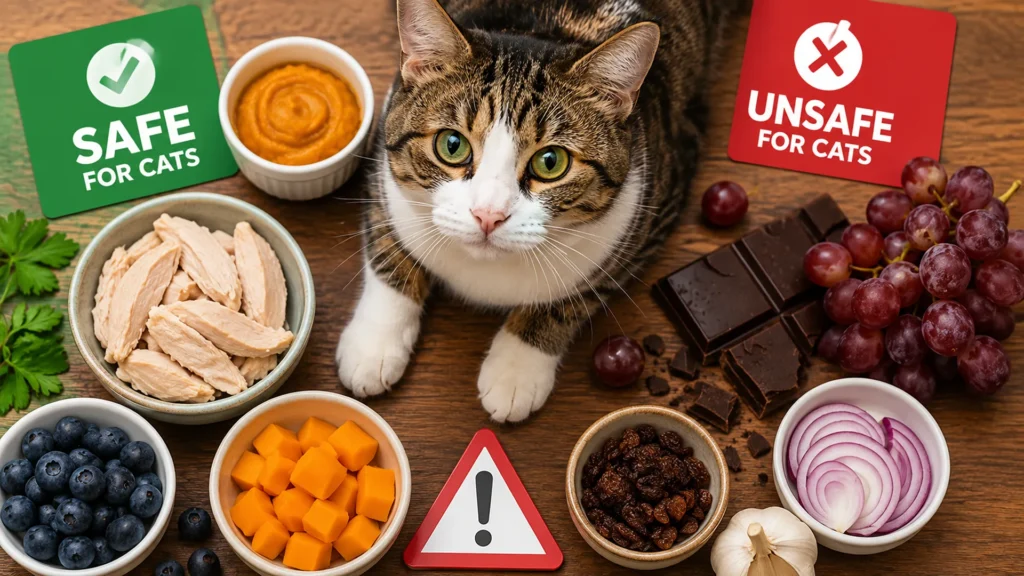
Some foods that appear harmless on a human dinner table can be dangerous to cats.
One particularly important group is the Allium family, which includes onion, garlic and chives. ASPCA warns that these foods can cause gastrointestinal irritation and damage red blood cells, potentially resulting in anemia, with cats especially susceptible.
Chocolate and caffeine are also dangerous. Chocolate contains methylxanthines such as theobromine and caffeine, while caffeine-containing foods and drinks can cause serious symptoms.
Alcohol should never be given to a cat.
Raw meat and raw eggs can carry pathogenic bacteria, while bones can cause injuries or gastrointestinal obstruction.
So a useful kitchen rule is:
When in doubt, don’t share it until you’ve checked.
Be especially careful with mixed dishes
This may be the most important practical lesson.
Imagine you’re eating chicken.
Chicken itself can be appropriate when cooked and served plain.
But your chicken was cooked with garlic and onion.
Now you’ve changed the equation.
The same problem occurs with tuna salad, casseroles, soups, sauces, pizza toppings, sandwiches, gravies and leftovers. A dish may contain one cat-safe ingredient alongside several ingredients that aren’t appropriate.
That’s why it’s usually safer to think about the entire dish, not just the ingredient your cat is trying to steal.
How much human food is too much?
Even safe human food can become problematic when portions get too large.
Human food should be a treat, not the nutritional foundation of your cat’s diet. PetMD recommends keeping these extras small and treating them as occasional snacks for otherwise healthy cats.
There’s another issue owners sometimes overlook: calories.
A bite that looks tiny to a human can represent a much larger proportion of a cat’s daily intake because cats are so much smaller than we are.
And if your cat receives chicken at breakfast, tuna at lunch, several treats during training, and scraps from dinner, those “tiny” extras can accumulate quickly.
What if your cat has a medical condition?
This changes the answer considerably.
A food that’s acceptable for one healthy adult cat may be inappropriate for a cat with kidney disease, diabetes, pancreatitis, obesity, food allergies, gastrointestinal disease, or another medical condition.
The same applies to cats eating prescription veterinary diets.
PetMD specifically advises checking with a veterinarian before introducing human foods when a cat has health problems or eats a prescription diet.
If your veterinarian has prescribed a particular diet, don’t undermine it with seemingly harmless table scraps without asking first.
What if your cat eats something dangerous?
Don’t wait for dramatic symptoms if you know your cat has consumed something potentially toxic.
Contact your veterinarian or an animal poison-control service promptly and tell them:
what your cat ate, approximately how much, when it happened, and your cat’s approximate weight.
Don’t induce vomiting or give homemade remedies unless a veterinary professional specifically instructs you to do so.
The same principle applies beyond food. Even beautiful things around the house can pose unexpected risks. For example, Are Tulips Toxic to Cats? What Every Cat Owner Should Know explains why a seemingly harmless bouquet deserves attention in a home with cats.
The safest way to share your food
You don’t have to completely stop sharing food with your cat.
Just make the moment intentional.
A tiny piece of plain, fully cooked chicken, turkey, beef, or appropriate fish can be an occasional treat for many healthy adult cats. Certain other foods may also be appropriate in small quantities.
But your cat’s regular complete and balanced diet should still do the nutritional heavy lifting.
And remember that your cat doesn’t understand the difference between plain chicken and chicken covered in garlic sauce.
It only knows that something smells incredible.
So the next time those enormous eyes appear beside your dinner plate, don’t ask only:
“Does my cat want this?”
Ask the question that matters much more:
“Is this actually safe for my cat?”
Leave a Reply